All posts by Chris M. Dickson

Coming soon: HIQORA, the High IQ World Championships

High IQ World Championships logoThere’s an interesting and unusual-looking online puzzle contest happening on Saturday 28th May: the first round of the 2016 edition of HIQORA, the High IQ World Championships. It has an interesting structure: there will be two online rounds, with the top scorers from the first advancing to the second and the top 12 scorers from the second winning flights to, and accommodation for, the live world final in San Diego. (No clue if there’s any prize other than the trip and the title, but that’s easily good enough alone.) The first round is set to start at 4pm UK time on Saturday 28th May, and will be held simultaneously around the world, so it starts at 8am in San Francisco, 11am in New York, 6pm in Moscow and so on. (The web site suggests that it starts at 8pm in Beijing, but this may be a typo.) Can’t help feeling that this is even more of an advantage to people operating on European time already, and it does seem a shame that there won’t be many people who get to start at 1pm, 2pm or 3pm, but any time is bound to inconvenience some more than others.

The duration of the first round is yet to be confirmed. “The two Online Rounds will each be up to four hours in length, and held simultaneously around the world. Activities and questions are drawn from the HIQORA Championship Framework which explores multi-disciplinary aspects of high intelligence. Examples of these activities and questions may include: learning to play a new board game; interpreting complex literature and language passages; interactive case studies; mathematics and graphical workouts; spelling bees; memory workouts; knowledge of geographical facts and figures; and various exercises across science, technology, education and maths (STEM).”

You may be given the rules to a new board game, or other pre-reading, 72 hours in advance and thus a relatively limited time to master it. That sounds like rather a fun sort of challenge. It’s tempting to wonder whether or not the championships will attempt to be culture-neutral. The signs would seem to point to that not being a top priority, and (at the risk of an interpretation, which this site would love to learn is incorrect) might seem to imply a focus on English language culture. On the other hand, this would appear to be only a small part of the focus of the overall test.

One comment in the FAQ is particularly striking: “(…) it’s important to note that HIQORA is a test of natural intelligence, so study as such is of lesser importance to success in the competition than natural abilities.” This site tends to believe that puzzle contests covered by this site generally tend not to go out of their way to make that sort of distinction, and this is the point at which it’s tempting to get a little cynical about the extent to which a contest truly could separate natural abilities from facility at, and familiarity with, IQ test puzzles. Had this been clearly marketed as, say, “an IQ puzzle championship” then this site would have embraced it with open arms. On the other hand, the wide variety of components to the challenge mean that it seems to be intended to be more than just an IQ puzzle championship. That’s fair enough and probably makes for a more interesting event, but can something culture-specific really be a fair test of natural abilities to people around the world for a true world championship?

By way of full disclosure, I’ve never taken a formal IQ test and Mensa has never seemed appealing to me. That said, the Mensa members I’ve met in person have been thoroughly convivial to a (non-gender-specific) man; when I was taken as a guest by a Mensa member to a Mensa meeting – for that is perfectly possible – I enjoyed my evening there. While I tend to be leery at best when it comes to exclusivity being sold as an inherent virtue, I am thoroughly supportive of the necessarily elitist World Puzzle Championships as adding to the jollity of the world, though much of my favourable opinion comes from the context of the WPF’s outreach and accessibility of its qualification and Grand Prix events.

Whether the trimmings and trappings of the contest appeal, you’ll know whether or not it looks like a fun way to you to spend a few hours. At worst, it would appear to have a lot in common with the sorts of contests and challenges that this site enjoys. While the inflexible timescale may hinder – for instance, I’ll be between night shifts – it’s far from the only contest to have specified a particular timeslot in an attempt to avoid some people getting to see the questions before others. While nominally some people are charged US$40 for participation, several sources online quote HIQORAHighIQ as a code for free entry.

If you take part, this site wishes you well – and please come back and tell us all about it!

Challenge Anneka? No, Challenge You

"Challenge Me" logoNot so long ago, on another forum, this site learnt of a casting call for a forthcoming ITV show provisionally entitled Challenge Me. “Do you have an unique skill or unusual party trick or know someone who does? Something that no one else can do? Could you use that skill to take on a huge challenge and win cash in the process?” It sounds something like a monetised version of You Bet!; let us not refer to the end-of-the-pier show that was the BBC’s Epic Win a couple of years ago.

The application page suggest that “We are looking for people with crazy, unique and bizarre skills and talents. These can be absolutely ANYTHING you can imagine! Big, small, serious or downright bonkers – we want you!” It’s not clear whether applicants have to be alone, or whether pairs or larger teams could apply. It’s tempting to wonder whether someone, or some people, could apply claiming “I can get out of any escape room” and then challenge ITV to build a room from which they cannot escape. It could make for some entertaining TV at the very least, though might well be out of the budget of TV these days.

However, if they want something a bit more straightforward, this site would like to see a sudoku champion take on a memory champion to produce a complete grid. The sudoku champion would see the grid with a usual number of digits placed, then would have to fill in all the missing digits. The memory champion would see the completed grid, memorise the position of all 81 digits, then reproduce it from memory. Both are impressive mental feats when done at champions’ speed; it would be possible to devise a sudoku of appropriate difficulty to make it a close, televisual race.

The unaffiliated-to-branded-beer world record for memorising numbers in a minute hasn’t been attempted for a while (different disciplines go in and out of fashion…) but with improvements in the pack-of-cards speed record, the 100m sprint of memory records, it’s tempting to guess that the top memorisers might be able to memorise the 81 digits in about 30-40 seconds or so, plus perhaps another 20-30 seconds to reproduce them from memory. There are plenty of speed sudoku solution videos out there; this one has Jakub Ondroušek (who has made the top three of the World Sudoku Championship five times) solving a 26-given puzzle in barely a minute and a half. Now you can’t calculate a sudoku’s true difficulty from the number of cells given, but it would surely be possible to create a sudoku which looked impressively sparse and difficult but could actually be solved to any given timescale.

There’s an interesting TV show in China whose title translates as The Brain. This has Chinese citizens with remarkable talents compete in domestic competition and the most successful competitors representing their country in international competition against representative teams from other countries. You can see China-Britain matches from last year and the rematch from this year on YouTube.

Clearly they’re all in Chinese, but you can fast-forward through to the challenges in which you can see the stars demonstrate their skills – and the UK team’s introduction videos have the UK team members self-introducing in English with Chinese subtitles and making all manner of exaggerated and aggressive claims at the producers’ request. These are huge fun, not least because British team captain Ben Pridmore (world memory champion in 2004, 2008 and 2009) is actually delightfully sweet and self-effacing in person, when some of his predecessors have been willing to cast themselves as relatives of Charles Big, who married into the Potato family and double-barrelled his surname.

US readers may be interested to know that Fox produced a one-off of a show called SuperHuman in January and are now casting for a full series, which bears a great deal of similarity to the Chinese format and which Wikipedia suggests may be a local US version. US puzzle superstars may be of particular interest to the show and might wish to throw their names into the ring; the trouble (for the show!) is that the best US solvers tend to be just as modest and polite as the aforementioned Ben…

Did DASH 8 leave you wanting more?

whatsnext

This site has always declared its constituency to be Escape games, puzzle hunts and more and the escape games have had to take a back seat for some time. Perhaps you’re coming here for your first time, or one of your first times, as a result of DASH, or perhaps you couldn’t go but thought it sounded great; you don’t have to wait another year for DASH 9 to get your fill of puzzle fun. The idea to try to keep a calendar of such things has rather fallen by the wayside, but there are plenty of exciting-looking things coming up:

  • This site is perhaps more excited about the upcoming Raiders of the Lost Archive than anything else. It’s a version of Citydash by the esteemed Fire Hazard, but has a big twist. It takes place in the Victoria & Albert Museum; the V&A are excited about this, but it’s not an official event of theirs. The difference between this and any other Citydash is “(…)this time there’ll be nobody chasing you (and no running in the museum!). We’ll keep the pressure up with twists & turns, surprise clues and leaderboard updates, but you won’t need your running shoes for this one – and you’ll be inside throughout.”
     
    If the running element of previous Citydash events has been a turn-off (*raises hand*) then this may well fit the bill and the theme is gorgeous. You can play solo, in a pair, or in a team of up to five. Tickets for Sunday afternoons in May are now listed for 15th May, 5th June and possibly 28th May. (Thanks to Ken for the heads-up!) 
     
  • The A Door In A Wall are, happily, continuing to put on their large-scale public events. The next one coming up very soon will be entitled Played to Death. “Each team will need a charged smartphone to hand and we advise you wear comfortable footwear as our story leads you out into the nearby streets in search of puzzles, clues and characters. (…) you’ll have about 45 mins to get settled and work out where to begin your investigation before the game’s opening scene. You’ll be tasked with gathering evidence to crack the case and you’ll then have two hours to explore the area outside: solving puzzles, interacting with characters and collecting clues. Once the time is up, return to the Square Pig ((pub)) where you’ll have some time to make sense of what you’ve found and identify the killer.”
     
    The game will be offered on most evenings and some afternoons (particularly at weekends) between mid-May and mid-June; tickets are already available and have sold out on a number of days already. If you don’t get to play, the company are also offering the A Veiled Threat game on the third Tuesday of every month, which The Logic Escaped Me played and loved. 
     
  • This site’s friends at Treasure Hunts In London are also continuing to run their events; the best way to keep in touch with what’s on offer there is their calendar on Eventbrite. Three events are coming up soon: May sees the Art on the Streets Treasure Hunt at the Chocolate Museum on the 14th and the Trafalgar Square Experience at the National Gallery on the 28th; June sees the Naughty But Nice Afternoon Adventure starting at the Annenberg Courtyard of the Royal Academy on the 18th. Prices vary, depending on whether the event includes no food, a cream tea or a full dinner. 
     
  • The Cambridge University Computing and Technology Society have held a long, ambitious, advanced puzzle hunt annually for the last three or four years, normally in early June after most students have finished their exams. No word whether there’ll be another one this year, but fingers crossed. The logical place to look for more information would be the society’s Facebook page. 
     
  • The Manorcon board game convention (15th to 18th July at the University of Leicester) is set to feature a puzzle hunt, probably on the Sunday afternoon. This year’s hunt setters are past hunt setting veterans and multiple-time solving champions, as well as some of this site’s favourite people in the world; attend Manorcon because it’s a tremendous board game convention that started running ten or twenty years before the current breed of board games started to become popular again, rather than just for the puzzle hunt. 
     
  • Before all those, there’s dear old Puzzled Pint in London – and now also in Manchester! – on the second Tuesday of each month, so as soon as the Tuesday in half a week’s time. The puzzles here come from a rather more DASH-like background, but are deliberately accessible to all and designed to provide an hour or two’s fun for a team enjoying food, drink and good company. 
     
  • If Tuesday’s too long to wait, or if London and Manchester are both too far to go, there are online puzzle hunts which come to you. The annual Melbourne University Mathematics (and statistics) Society hunt starts at midday, local time, on 9th May. It’s designed for teams of up to ten; you’ll recognise some of the participating teams’ names from the top of the DASH leaderboard, but other teams come from the MIT Mystery Hunt tradition and more. Suffice to say that the MUMS hunt has gained an audience who like to spend hours on deep, research-y, Aha!-y puzzles, though they’re almost always brilliantly constructed. 
     
  • Staying online, if you like logic puzzle contests then the calendar also looks busy. The World Puzzle Federation’s Grand Prix season’s contests take place every four weeks, with the next starting on Friday 13th May. The next contest is set by the US authors and may be of particular interest; more soon. The move to featuring “casual” puzzles as well as the more high-powered traditional fare adds massively to the fun as well as the accessibility. That’s not all from US authors, though; the US Puzzle Championship will be on Sunday 18th June. Before that, HIQORA takes place on Saturday 28th May; more soon on that one, too. Look out (perhaps at @ukpuzzles on Twitter?) for news of the UK Puzzle Championship as well, which has rapidly become this site’s favourite of the year. Previous UKPCs have happened in May, June, July and August, so this year’s event could happen at any moment. Exciting times!

The annual DASH participation statistics post

Bar chart showing improving performance over timeIf it’s a few days after DASH, it’s time for the annual participation statistics post! Please find below an updated version of a table which details the number of teams on the scoreboard for each city in each edition of the DASH puzzle hunt to date.

Location DASH 1 DASH 2 DASH 3 DASH 4 DASH 5 DASH 6 DASH 7 DASH 8
Albuquerque, NM – – – 6 6+1 3+2+0 4+0+0 –
Atlanta, GA – – – – – – – 5+7
Austin, TX – 2 11 12 13+4 10+4+0 17+6+0 20+4
Bay Area, CA Y(SF)
Y(PA)
7(SR)
59(LA)
16(SR)
74(SM)
73(SF) 34+7(SF)
32+3(HMB)
53+17+0(SF)
39+5+0(C)
46+15+0(SF)
37+7+0(SJ)
48+10(SF)
43+12(PA)
Boston, MA Y 18 26 29 27+2 30+7+1 30+6+0 38+13
Chicago, IL – – 17 14 10+1 15+9+0 16+24+0 16+16
Davis, CA – 16 15 16 13+7 8+7+1 13+7+0 12+8
Denver, CO – – – – – – 3+12+0 6+7
Houston, TX Y – – – – – – –
London, UK – – – – 6+2 8+13+0 14+9+0 14+8
Los Angeles, CA Y 7 22 21 15+4 15+2+0
(Pasadena)
12+7+0
(Sta Monica)
19+17
Minneapolis, MN – – – – 8+7 7+4+0
(recast)
9+7+0 7+9
New York, NY – 12 24 25 30+7 26+15+2 29+15+0 24+15
Portland, OR Y 6 17 19 19+2 11+7+0 10+10+0 12+5
San Diego, CA – – 7 – – – – –
Seattle, WA Y 32 47 49 49+2 58+4+2 60+9+2 63+6
South Bend, IN – – – 1 – – – –
St. Louis, MO – – – 2 2+3 – 7+8+1 8+10
Washington, DC Y 14 22 33 31+1 27+5+0 26+9+0 28+12

Here are some initial interpretations:

1) Errors and omissions excepted, with apologies in advance. The Minneapolis DASH 6 recast figures came from the organisers by private e-mail.

2) The numbers are drawn from the scoreboards and may not reflect teams that participate but do not make the scoreboard for whatever reason, or other infelicities. (On the other hand, it does include teams which do make the scoreboard even despite being listed as “not started”.) DASH 1 does not have a public scoreboard on the web site and thus “Y” represents the hunt having happened there with an unknown number of participants. When there are pluses, the number before the first plus reflects the number of teams on the experienced track, the number after the first plus reflects the number of teams on the “new players” track (DASH 5, 6, 7 and 8), and the number after the second plus reflects the number of teams on the junior track (DASH 6 and 7 only).

3) Interpret “Bay Area, CA” using the following key: SF = San Francisco (1, 4, 5, 6, 7 and 8), PA = Palo Alto (1 and 8), SR = Santa Rosa (2,3), LA = Los Altos (2), SM = San Mateo (3), HMB = Half Moon Bay (5), C = Cupertino (6), SJ = San Jose (7). (Santa Rosa counts as Bay Area, doesn’t it?)

4) It’s not a competition to see whose DASH can be the largest; all DASH organiser teams are glorious, generous paragons of virtue, whether their event had one team or 70+, and the community at large thanks them all for the time and effort that they put in.

5) Many locations had events that were similar in size or even slightly smaller (perhaps for reasons as simple as a higher number of teams who pay but, for whatever reason, just don’t show on the day) than the previous year. As discussed, there’s no reason why bigger necessarily has to be better and there’s no sense in deliberately trying to emphasise quantity over quality. It’s tempting to wonder how much unmet demand there is in the various cities around the world and whether everyone who wants to play is getting to do so in practice.

6) The line-up of 16 locations participating in DASH 8 was actually very similar to that for DASH 7, representing only a substitution of Atlanta, GA to replace Albequerque, NM. Registration was also offered in Missoula, MT, but the event did not happen in the end. The growth in Puzzled Pint over the year has been explosive with 32 locations in April 2016 against 14 in April 2015; it’s true that some of those were previous DASH cities, but surely it seems likely that some cities will go from Puzzled Pint to DASH – and beyond? – rather than the other way around. PP is currently played in five countries; it also seems plausible at the very least that DASH will start to catch up before much longer.

7) The overall numbers of teams has risen over the last three years from 295 to 307 to 333 to 363 on the “experienced” track and from 53 to 101 to 151 to 159 on the “novice” track, with every location featuring at least one team on each of the two tracks.

Drawing a line from one DASH to the next

DASH 008 in London needed its teams to go underground!

DASH 008 needed its teams to go underground! From @playdashlondon

This is a guest post by David J. Bodycombe, one of the UK’s foremost puzzle authors. You may know his work from The Crystal Maze and Only Connect or perhaps numerous books and periodicals. At the very least you probably know that car park puzzle; to this site’s taste, he’s written easily two thousand much more interesting ones over the years, but you can never tell what’s going to catch the public’s imagination…

Last year, as a participant of DASH 7, something didn’t feel… right. When I got home and had to explain to my wife whatever the heck I’d been doing for the day, I sensed that I hadn’t had that much fun. The company was great, but the frantic time limits, a lack of food, an unfortunate route and a brute of a final puzzle left me thinking “Maybe I won’t do it next year”. But with DASH 8 promising a Brit-friendly theme of James Bond, how could I say no?

Last year, I put down my thoughts on how DASH could improve, both as a podcast and as a summary post in the comments. I make no personal claim for any improvements made but, since it is this site’s frequent milieu, I thought it might be fun to look back and see how much of my wishlist was catered for this year.

(1) DITCH THE TRACKS.
Partially. The Junior track has gone, tailing the tracks from three to two. Frankly, the junior track was never going to be a long-term possibility in London, particularly with its 18+ pub culture being a supplier of many indoor venues. The prospect of expecting a chaperone to guide teenagers around the busy streets of London on a Saturday was a tough ask, and I agreed with a commenter last year who said that there would be better value in making the puzzles available for schools to run their own mini-puzzle drives. I still believe the differences in the Normal/Expert tracks cause more doubt and administration complexity than is worth, and that homogenisation of the tracks wouldn’t affect more than 5% of the teams.

(2) MINI-TASKS SHOULD BE IMPRESSIVE, OR GOOD JOKES, OR OMITTED.
Yes. In past years, it was hard for Londoners not to look on the DASH social media feeds with a feeling of jealousy. Somehow, DASH seemed cooler there – better themed, better spaced and better stunts. Not so, this year. If anything, London may have been *the* place to DASH – particularly with the start point a stone’s throw away from the on-theme MI6 headquarters. Imaginative mini-tasks plus the tremendous innovation of optional ‘HMSAT tests’, some of which required teams to be observant and quick-witted at all times, added immensely to the occasion.

(3) WE NEED TO BELIEVE GAME CONTROL.
and
(4) THE RULES NEED TO BE CONSISTENT FOR EACH LOCATION.
Yes. Last year, the slightly rubber-banded rules, where different locations were allowed to be flexible about when to end the hunt, led to a lot of confusion and disappointment. This particularly applied to my team last year, as we quit early not realising that the advertised “strictly-enforced 8 hour time limit” was actually no such thing. This year, the sensible thing was done – a 10-hour limit was the same for all (AFAIK) and even an overall countdown timer was there on the ClueKeeper to avoid any anxiety.

(5) IMPROVE THE SCORING.
Partially. Still some work to do, here. In particular, the scoring was not explained on an info sheet this year, so lord knows what DASH newbies thought of it. But, again, puzzle 1 was not worth anything. This means that some teams (maybe well-meaning latecomers) are simply typing in the answer that their mates have told them, meaning that ClueKeeper’s stats credit them with solving the puzzle in a world-beating 7 seconds, and thus denying the ‘real’ winning team from getting a little gold cup next to their name. I still think it should be worth something – either a flat score, or a low Par value to indicate that you shouldn’t spend too long on it. Another wish of mine from last year was to allow more opportunities for bonus points. This was indeed achieved, but only in the distinctly cheeky manner of ramping up the total Par time to a little short of 7 hours. Hmm.

(6) MAKE THE PROPS BETTER OR DITCH THEM.
Yes. A big win. You couldn’t say that this year’s DASH was “just Puzzled Pint with walking”. The advantages of DASH’s economies of scale were definitely evident this year and, more to the point, the props had a puzzle purpose to them rather than just delivering a codeword answer.

(7) MAKE THE CONTENT ACHIEVABLE BY MOST.
Yes. Though our team quit on the final puzzle this year due to taking too long on puzzle 9, looking at the general ClueKeeper statistics it’s easy to see that almost all teams had the opportunity to finish within the time allowed.

With these feedback points largely addressed, I offer up another set for discussion:

(A) EASE UP ON THE CONSTRUCTION?
This is one area that really hurts smaller teams. While DASH has never claimed to be any fairer to teams of 3 than 5, nevertheless the fairly extensive nature of some puzzles that required the teams to build paper or wooden models would have added minutes (maybe tens of minutes) to the scores. The news near the end that *every* team member was *required* to have scissors really took me aback. And, I say this slightly seriously, if I ever make it to DASH 38, I wonder how my arthritic fingers would cope with things like folding paper cranes. Does against-the-clock building further discriminate against the less physically able? As other commenters have noted, the time difference in time taken for construction often made the ClueKeeper out-of-sync with the team’s progress.

(B) CHOKE BACK ON THE PUZZLE LENGTHS
Although the average solve times seem much more in line with previous years this time around, and the overall event pacing was better too, there did seem to be an expectation that teams would have to spend 9 hours overall this time rather than 8. I would like to see the par time come back down to nearer 6 hours. This, plus an hour for eating and 90 minutes for travelling, still adds up to a pretty packed 8.5 hours. How could this be done in practice? I would say: by keeping the starter puzzle shorter (it was quite a Googling-heavy brute this year), by keeping most puzzles sub-45 minutes, and by having a slightly more robust attitude to starting on time. Puzzle 5 (par: 75 minutes) was way too long for a lunchtime activity – my usual team usually finishes an entire evening of Puzzled Pint (four puzzles and a meta) within 75 minutes!

(C) TO PREP OR NOT TO PREP?
Despite following DASH on Facebook and Twitter, somehow I missed the “Advanced Training” which gave information on two things: how to solve cryptic crossword clues, and how to fold paper cranes. If you’ve never solved a cryptic crossword, to somehow learn this skill in the week before DASH is asking a lot. What next? You have a week to speak fluent Klingon, or learn to juggle? I’ve seen some people suggest the rules to Baccarat should have been made available beforehand, to which I heartily disagree: it would have put even more advantage to the teams that have spotted the pre-game information.

(D) GIVE SOME INDICATION OF ‘DWELL TIME’
It would be appreciated if the route information could more heavily hint if teams are likely to stay in a location for a long period of time – particularly where locations ‘double up’ for two puzzles. For instance, at the morning meeting point there was a heavy sense of “Do I bother to buy a coffee or not?”. You don’t want to be mid-croissant when ClueKeeper cheerily guides you to your next location 2 miles away. No-one wants that.

(E) BEAR THE BRITS IN MIND…
DASH GC have a little more way to go to make it feel like a global-inclusive event, rather than London being a “+1”. For instance, I winced when – given the event’s British/James Bond theme – we had to release puzzle 1 on ClueKeeper by spelling the word LICENCE the “wrong” way…

Overall, my team rated this year’s DASH as a ‘solid 8/10’ which should be interpreted as a very good score for such a complex event, and a definite improvement from last year. Particular thanks should go to London’s GC who stepped in to help when all others stepped back, and added notable innovations and flair that I hope future GCs will emulate. I very much look forward to DASH 9.

(Full disclosure: due to a family medical emergency, I had to pull out half-way. As a result, some of this post uses feedback from my teammates or other third-hand information.)

Mission accomplished – DASH 8 described

DASH 8 deck of cardsThis site makes no apology for writing a considerable quantity about DASH with just as considerable delight; it’s always one of the highlights of the year. If you couldn’t attend this year, here’s what you missed… and perhaps, just perhaps, it might make you interested in taking part in a future year. If you played DASH elsewhere and were keen to know how London interpreted this year’s puzzles, you can find out here as well.

Fair warning: now that DASH has finished, we’re into potential spoiler territory. Every previous DASH has had its puzzles posted online reasonably soon afterwards. If you didn’t play DASH, it would still be a lot of fun to get a group of your friends together and try the puzzles for yourself once they’re made available. This post is going to be fairly generic, avoiding the Aha! moments for each puzzle, but the comments may be more specific. Nevertheless, if you want to avoid spoilers altogether, it may be wise to skip this post and it may be very wise to skip the comments. However, if you played and want to relive the experience, if you played elsewhere and want to compare stories or if you know you’ll never play this year’s puzzles and just want to find out what you missed, then to get to the detail you can click on the mission dossier that is the “Continue Reading” button below. Continue reading Mission accomplished – DASH 8 described →

Some quick comparisons between editions of DASH

DASH logoThere’s no editorial here, and definitely no intent to suggest there is such a thing as an optimal set of values, but this might still be of interest to set some context for comparison purposes. The times refer to puzzles offered in the most popular (i.e. expert/experienced) track from DASH 5 onwards.

Edition Par time Fast* time Usual* time Teams Structure
2 5:00 1:51 4:32 173 8+M
3 6:00 2:57 6:42 298 8+M
4 6:00 1:53 4:48 300 8+M
5 4:30 2:14 5:32 295+N IB+7+M
6 5:50 2:33 5:10 307+N IB+8+M
7 5:45 3:38 6:55 333+N IB+8+M
8 6:40 2:33 4:35 363+N IB+7+M
* median,
top-11
* median,
middle-8/9
N = normal track M = metapuzzle,
IB = icebreaker

Data remains available for DASH 2, DASH 3, DASH 4, DASH 5, DASH 6, DASH 7 and ((edited:)) DASH 8. Note that the usual time was calculated from the median time quoted for either the middle-scoring 8 or 9 teams, depending on whether the overall number of teams was even or odd, and may not represent every puzzle being solved without a hint or even every puzzle being solved at all. The times quoted do not include the par or solving times for the unscored co-operative icebreaker puzzle from DASH 5 onwards.

DASH 008? More like DASH GR8!

Mötley Clüe at the end of DASH 008If you couldn’t be at DASH 8, you missed a total treat. The picture above tells a thousand words by showing the reaction of the team I played with at the end of the hunt. The most specific compliment that the hunt deserves was that it was really smooth; the administration in London was spot on, the puzzles were very cleverly designed and the playtesting proved effective, so the overall effect for our middling-performing Expert-track team was that we didn’t encounter any glitches and enjoyed the ride… albeit at more of a trot than at a canter, let alone a gallop. It was clear that a lot of lessons were learned from last year.

Congratulations to Misremembered Apple for being clear winners of the Expert track in London, and to Team Reckless of Escape Review and friends for being clear winners of the Normal track in London. After the hunt finished, it was fun to watch the live ClueKeeper scoreboard, as if it were a Gillette DASH Saturday and Matt le Tissier were shouting “Oh! Soooolve!” as incremental results came in. While not all the results are in yet, provisional returns point to The Judean GNUs and LXP of Palo Alto being the world’s top two; congratulations to them, too. Early leader in the “best team name” contest might just be Quantum of Solvers.

Thank you to all the staff, volunteers and people behind the scenes worldwide; you’ve made a lot of people very, very happy. The event proceeds apace not just as a puzzle championship but also as an increasingly social event, with so many teams familiar from the flourishing Puzzled Pint. The event was so spectacular that the post-event buzz fading left a void; here’s looking forward to the next one!

DASH 8 is set to shake (but not stir?) on Saturday

DASH 8 logoIt’s been a busy old week here, oddly enough, with the reward at the end being the DASH 8 puzzle hunt in London and 16 cities across the US. While this site won’t be putting together a predictions post like the one last year, the weather forecasts point to a hope that the afternoon’s puzzles can be situated in locations with shelter. For at least two of the last three years, the forecast on DASH day has been for a risk of rain which has manifested as a few stray spots at worst, so perhaps the world shouldn’t have much cause for complaint if luck is not on our side.
This site hazards a guess that this year’s codes sheet will look like the image on the tote bag and plumps for the NATO alphabet to make an appearance this year as being vaguely thematic, with a second guess being that it’s time for a hex code to make an appearance. Similarly, the logo on the T-shirts (and the other tote bag) hides analogues to morse and braille at the very least. Iiiinteresting. Much as last year’s DASH had a location at King’s Cross station, to take advantage of the thematic link to the actual fictional Platform 9¾, it’s tempting to note that this year’s London start location is just on the other side of the Vauxhall Bridge and barely a couple of hundred metres from what is known to the public as the MI6 building. Might the hunt’s route take us closer still?

My team this year will contain three-quarters of our DASH 6 line-up (not the chap in the middle) – sadly, we will not be as impeccably dressed as the most famous fictional secret agent of them all. Do please say “Hi!”; it’ll be lovely to see you! The continued growth of Puzzled Pint should surely mean that the community gets ever stronger and more teams will know (or, at least, recognise!) each other. Assuming that the logistics permit, why not stay around for a drink and a chat with your fellow solvers at the end, if you can? (Especially you brilliantly quick front-running teams, though I know you’re busy people who might not be able to hang around to let us catch up!)

Many thanks to all the people who have put together the hunt: the global co-ordinators, all those who helped playtest and test-solve and the London volunteers on the day. It’s going to be a great day!

Who cracked The Crystal Maze?

It’s been a good couple of days. After the unconference on Monday, another plan came together after a long, long time. Last June, this site proposed a get-together for the exit game industry at the then-planned live The Crystal Maze attraction. A thousand pounds was duly plunked down and all 32 places were resold to exit game owners, staff and enthusiasts. Many months later, all 32 people turned up and formed four teams of eight to travel the four zones. (Special apologies to Escape Hour who had to cancel due to flu, but at least their tickets were resold and nobody missed out.)

Tuesday saw some unexpected weather in the morning – at least one thunderclap, some sleet and possibly some hail – but this didn’t stop people getting to the venue in good time. Each team of eight has its own mazemaster that marshals them; the teams circulate about the zones so that each zone is played by each team in turn, the four teams coming together for the Crystal Dome finale. The mazemasters do not attempt to be authentic replications of Richard O’Brien or Ed Tudor-Pole, but they’re very much in a spirit that fits the tone of the enterprise.

Each team member can expect to play two games over the trip around the Maze, but a fast team can fit more than four games per zone in. Some games are original, some are faithful to the show… possibly to a fault, but in any case there has been considerable thought put in to ensure that the whole team are engaged and feel like they’re getting their money’s worth even when they aren’t the ones who have the chance to get their hands on a crystal… or to get locked in. The winning team managed to play a total 19 games over the course of their trip around the Maze, winning a total of 15 of them. The record is apparently bringing 18 crystals to the Dome, so 15 is probably very good.

I took photos of the four teams at the start. I took ten photos in all and not one of them was good enough to use here. Fortunately there are official photos taken at the end and posted to Facebook (hence the day’s delay in making the post…) so here goes:

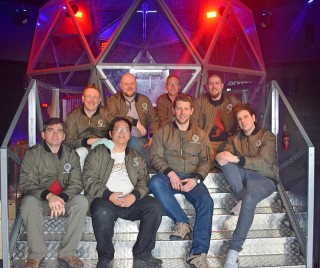
Team Breakout at The Crystal Maze Team Breakout: 192 tokens (15 crystals)
Breakout Manchester
Breakout Liverpool
Agent November
James Curtis
Jason Cook
Nick Gates
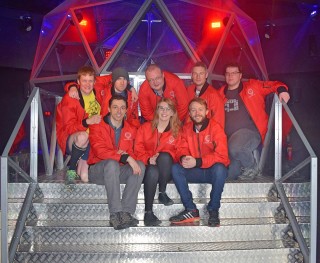
Green Dreams at The Crystal Maze Green Dreams: 170 tokens (13 crystals)
Escape (Edinburgh/Glasgow/Newcastle)
Dan Egnor
Wei-Hwa Huang
Gareth Moore
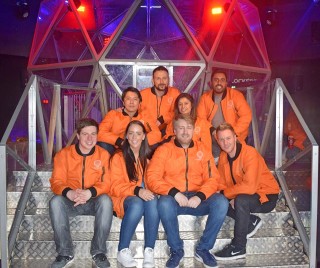
Orange Team at The Crystal Maze Orange Team: 163 tokens (11 crystals)
Escape Live (Birmingham/Essex)
The Escape Room
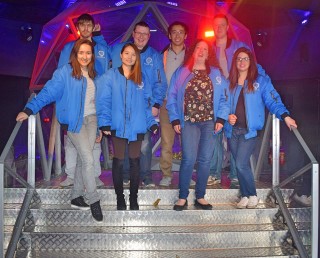
Blue Team at The Crystal Maze Blue Team: 124 tokens (11 crystals)
Escape Quest
Enigma Quests
Archimedes Inspiration
Larger versions available in the official site’s album
(Presumably their copyright)

The faces during and after the Crystal Dome were covered in smiles, which is a fine recommendation from a picky audience. I didn’t play; my own game is in six weeks’ time and I’m looking forward to it more than ever. If you want to know more – ideally, if you’ve already played, or if you just don’t mind spoilers – then take a look at Nick Gates’ detailed write-up of his experience. Recommended!

It was fun (and somewhat like a certain part of Back to Reality from Red Dwarf) to stay and chat long enough to see the next set of four teams go through. Some of the mazemasters there sang and danced along to the music while the teams grabbed tokens in the Dome, which was cute, though surely rather more practiced and less improvised than they’d have liked it to appear. Top score in the next game was 150, which wouldn’t have got even third place in this game, which reinforces how well you all did.

Maybe I didn’t get to play myself, but while the teams were travelling the zones, my time was far from wasted. More of that soon, perhaps!