All posts by Chris M. Dickson

London puzzle hunt theatre: “a door in a wall”

"a door in a wall" logoThe process of learning about new projects is exciting: a passing mention of something unfamiliar in a Tweet here or there, which leads to something unknown to explore. Sometimes you turn up something very exciting that you never knew about. Maybe it’s an exit game, maybe it’s a contest, maybe it’s something like this.

Since 2008, event company a door in a wall have been organising treasure hunts and other interactive games, mostly in London. Sometimes they’ve run for a single night, sometimes they’ve been season-long engagements so that people could attend the performance of their choice. I very much enjoyed this photo essay by Alexa Loy of their “Sheikhs on a Plane” game in 2012; it’s clear that some of the clues involve code-breaking or are otherwise explicitly puzzle-y, making them likely to be of interest to readers. Interviews with principal Tom Williams (The Londonist in 2011 and Little London Observationist in 2012) lead me to like the way he thinks.

However, it’s clear that puzzles are only part of the hunt experience; even in Larry Hosken’s notes from Ian Tullis’s recent “Advice for a Puzzle Snob” talk at the 2014 Game Control Summit, “Talk around the water cooler next week will be about a gadget or a location; not about your puzzle“. The reviews for a door in a wall‘s work indicate that their actors, scenarios, locations and interactions are well worth the money. The fact that the same game is being run many times means that many more fixed costs can be amortised per player. (Arguably, it de-emphasises competition, too.)

Coming up in May and June is their new murder mystery game, The Diplomatic Corpse. “In the ever-volatile country of Paudaguay, you’re never too far from danger […] the Paudaguayan ambassador, Emilio Ninkash, has been murdered within his own embassy. […] In this time of peril, will you answer your consulate’s call to investigate the crime, restore tranquility to our diplomatic community, and bring the killer to justice?” The game will run every evening from 2nd May to 15th June, with additional afternoon dates on some days. It’s a game for teams of ideally 3-6, each team with one video smartphone and a willingness to explore central London. Teams can be formed in advance or on the day and up to fifty tickets are sold per show.

Tickets are now on sale. The standard price for a 4½-hour experience is £30 per player, plus booking fees, though there are still a couple of tickets available at £20 per player for the preview show and Twenty Something London have a code for 20% off on the first three Tuesdays.

It’s tempting to consider a door in a wall to be akin to a British Ravenchase, Shinteki or Mastermind Hunts (etc.) with their mix of public and corporate games. Resemblances can also be drawn to the Walking Shadow Company‘s “theatrical game with puzzles” tradition; their Saboteur game is wonderful to read about and I hope their Cabal game makes it to the stage some day soon.

The Magpie

"The Magpie" magazine logoAnother major UK puzzle hobby that I have not yet touched upon is that of the cryptic crossword. This may well be the hobby that has most hardcore participants. It’s not something that I’ve delved into deeply; there are many guides to how to solve cryptic crosswords, and I’ll link to Peter Biddlecombe’s guide. Peter has probably the definitive, though avowedly unofficial, page of information on The Times Crossword Championship; he won the competition himself in 2000 and 2007 and has since become the Sunday Times’ Crossword Editor.

The winner in 1999, then each year in 2008-2012 (oh, and 2013!), Mark Goodliffe, is the co-editor of The Magpie, a specialist monthly cryptic crossword magazine. “We publish puzzles with a range of difficulties, but solvers familiar with advanced cryptics such as the Enigmatic Variations in the Sunday Telegraph, the Inquisitor in the Independent on Saturday, and the Listener in the Times on a Saturday are the primary audience.” Indeed, the magazine’s own difficulty grading system has “only slightly more difficult than a standard broadsheet cryptic” at the low end, and goes up to levels higher than even those most difficult ones found in print. You’ll know whether this is attractive to you or not already, but the free sample issue number 60½ is the best way to find out for real.

Counterpart high-end crossword magazines exist, but not many; One Across has a remarkable heritage. I’m not sure if The Crossword Club is still running.

Goodliffe is not just a crossword champ, though. His personal blog is consistently great; he is a very accomplished sudoku solver as well, making the home team for the World Sudoku Championship held here in the UK this August. He was part of a team representing The Magpie who did exceptionally well in DASH 5 (seventh globally from a standing start, playing on a team constructed partly at the shortest of notice) and I also had the joy of introducing him to Puzzled Pint in February. Smashing bloke!

Within two weeks of the DASH puzzle hunt in London and the US

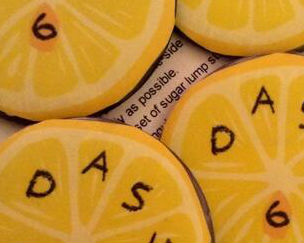
DASH "sugar lump"As previously discussed, the Saturday after next will see the sixth DASH puzzle hunt take place in London and in a dozen cities across the US. We don’t know much about it, though this Tweet from a team running the playtest in Portland inspires the above picture and gets us thinking about “sugar lumps”. Hmm.

The DASH Facebook page has also been running a series of previews of local co-ordinators. Dan Egnor, who has forgotten more about puzzle hunts than I have ever known, has said on Google Plus “This is so gonna be in a puzzle…” – it’s not really the DASH way to feature pre-clues, but there’s always a first time, and nobody ever said “This is not a clue” – so perhaps, just perhaps, never a truer word spoken in jest.

The great scholarly work of puzzle hunt puzzle taxonomy is Joe DeVincentis’ MIT Mystery Hunt Puzzle Index. If ever you want to astound people with the breadth of what can be achieved in a puzzle, that categorises over eighteen hundred of the hardest. In a similar vein – though I must admit insufficient familiarity to be able to use the same categories as Joe – I have attempted a similar analysis on the puzzles of the first five DASH events to date:

2009 Palo Alto: music (identification from audio samples), letter links
2009 Boston: picture identification, poker, indexing
2009 Los Angeles: phonetic letters and numbers (NV = envy or single letters), indexing
2009 Washington DC: poker, indexing, reading vertically
2009 Houston: physical puzzle, paper dolls, logic puzzle based on elimination
2009 Portland: picture identification, westerns, Morse
2009 Seattle: crossword clues, overlapping words, reading last letters
2009 Palo Alto: wordplay induction to deduce hidden rules (sports teams, phonetic letters, A=1 B=2, double letters, phonetic alphabet, identify countries, palindromes)
2009 Meta 1: rock scissors paper, wordplay from puzzle names and answers
2009 Meta 2: semaphore, rock scissors paper, wordplay from puzzle names and answers
2010 Alvin and the Chipmunks: music (identification from audio samples), word rebus
2010 The Brady Bunch: identification of pictures, induction of common themes, sorting, indexing
2010 CSI: Orlando: identification of pictures, Disney movies, sorting, indexing
2010 Late Night with Conan O’Brien: identification of pictures, TV shows, hidden words within quotes, extraction of extraneous letters
2010 Dancing with the Stars: soundalike gibberish, constellations, combining pictures to spell letters
2010 How I Met Your Mother: wordplay linking pick-up lines and logos, braille
2010 LOST: crossword clues, sorting logos based on colour clues, indexing
2010 Star Trek: identification of characters, bases other than ten, arithmetic applied to letter numbers
2010 Twilight Zone (Meta): mapping phrases within answers to buttons on remote control, mapping data to lines to letters, using one physical prop on another built up during the hunt
2011 Snow White: Snow White character names, hidden words within quotes
2011 The Town Musicians of Bremen: music (identification from audio samples), dot-to-dot lines travel over letters
2011 Cinderella: creation of physical prop, recognising physical prop’s ability, identifying common letters in pairs of words
2011 Rumpelstiltskin: trivia questions, picture rebuses, recognising letter shapes
2011 Rapunzel: creation of physical prop, pattern matching, arithmetic applied to letter numbers
2011 Chicken Little: wordplay induction to deduce hidden rules, letter binary code, identifying letter patterns in grid
2011 Hansel and Gretel: wordsearch (slight variant), letters not used in wordsearch, wordplay induction to deduce hidden instruction
2011 Jack and the Beanstalk: creation of physical prop, wordplay induction to deduce hidden crossword clues, crossword clues, word rebus
2011 Three Little Pigs: number logic puzzle, crossword clues, induction of common theme
2011 Meta Puzzle: wordplay induction on previous answers, crossword clues, jigsaw, maze, symbol identification, indexing
2012 Golden Gate Bridge: crossword clues, identification of states, dot-to-dot lines travel over letters, letters not used in grid
2012 Mausoleum At Halicarnassus: wordplay induction to deduce hidden instruction, binary decoding, semaphore
2012 Temple of Apollo at Delphi: crossword clues, triple homophones, indexing
2012 Great Wall of China: identification of pictures, wordplay induction to deduce hidden instruction
2012 Lighthouse At Alexandria: geometry, wordplay induction to deduce hidden instruction, counting
2012 Great Pyramid of Giza: crossword clues, wordplay induction to discover hidden instruction for filling crossword, use of hidden instruction on diagram provided
2012 Statue of Liberty: anagrams, wordplay induction to discover hidden instruction, use of hidden instruction on diagram provided
2012 Tower of Babel: crossword clues, flavourtext induction to discover hidden instruction, rhymes
2012 El Castillo (Meta): creation of physical prop, wordplay induction to discover hidden instruction
2013 Verify the Disorder: sequence dialogue, hidden quotes, foods and words within dialogue, matching to diagrams, recognising letter shapes, dot-to-dot lines travel over letters
2013 Identify the Affected Area: crossword clues, wordplay induction to discover hidden instruction
2013 Discover the Infection: puns, anagrams plus extraneous letters
2013 Find Patient Zero: hidden connections, binary code
2013 Isolate the Infection: mini-puzzles, crossword clues, cryptic crossword clues, hidden words within quotes, anagrams
2013 Determine Transmission: crossword clues, overlapping words, use of physical prop
2013 Develop a Cure: identify pictures, wordplay induction to discover hidden instruction
2013 Plan Distribution Method: identify grid positions, flavourtext induction to discover hidden instructions
2013 Complete the Cure (Meta): wordplay induction on previous answers, creation of physical prop, jigsaw, hidden message

So what can we learn?

  1. DASH is pretty wordplay-heavy compared to many other puzzle hunts, and there have been relatively many “interpret the flavourtext, or the answers, or other wordplay in order to deduce hidden instruction” puzzles over the years.
  2. Common tropes: extracting unused letters from words or anagrams, wordsearches where the unused letters in the grid are somehow crucial, dot-to-dots where things crossed by the lines are crucial, identifying words hidden within phrases or longer pieces of text. The theming is normally pretty important, too. To be fair, none of these are particularly exclusive to DASH.
  3. The meta puzzle often relies on some commonality between the answers, so a really smart team might be able to start to identify that commonality even before they have all the answers, then presume the existence of the commonality in the answers that they have not yet reached. We haven’t had a meta that’s in part to do with the puzzle names for a while, so perhaps that might turn up again before too long.
  4. Some of the earlier DASHes relied fairly heavily on US culture, which I think was dialed down a little for DASH 5 now that the UK has entered the fold – and, given that there’s no reason why it couldn’t spread further around the (at least the English-speaking or English-speaking expat) world, this might decrease further still over time. I get the impression that one concession for London in DASH 5 is that we were presented with a list of US postal state abbreviations that we might not be expected to know but that US solvers might – and if there are any counterparts for further DASHes (lists of state capitols? Lists of Presidents and their numbering?) don’t expect them to be red herrings.
  5. Looking at the scoring, DASH 3 was unusually long compared to the others, with particularly many physical prop construction puzzles that slowed teams down. Another relatively long one may roll round again at some point.
  6. It’s not at all an admission of defeat to take hints; the median teams may or may not take hints, but taking a hint will not necessarily exclude your team from finishing in the top 20% of all teams, or maybe even significantly higher than that – particularly if you’re fast everywhere else in a relatively long year.

Really looking forward to this year’s event, not least to getting to see lots and lots of lovely people in the same place at the same time, even more than at a Puzzled Pint. More on that soon!

The UK’s puzzle show tradition

"Treasure Hunt" UK tv show logoYesterday, I hinted that the then-upcoming Schlag den Brig would be spectacular; happily, this proved to be the case. The two contestants were mailed a package of several envelopes that they were not to open until directed by the appropriate game. Having opened envelope “A” for game one and been required to set up a short chain of dominoes while blindfolded to topple, and having been required to write poetry against the clock for game two, game three was a treasure hunt. Specifically, a treasure hunt through a book contained in envelope “B”. If you’ve got just over 20 minutes, it’s well worth a watch.



If you have less time and want to skip to the exciting conclusion of the treasure hunt game, skip forward to about 1:03 or so. On the other hand, if you’re not in a rush, scroll back to 0:00 because the entire just over five hours is well worth watching; there’s a great deal of inventiveness from start to end and the ordering of the games marvellously jumps from the light of inherently silly games taken very seriously to the shade of serious quizzes and strategy, then back again as the tension mounts. Contestants Nick and Dan play with skill, style and great humour; Game devisor/curator David J. Bodycombe has a real grasp of originality and comedy. The variety required of the contestants, and the play-along value for viewers at home during several of the games (in a way demonstrating how watching live shows over the Internet can enable richer participation than watching regular TV) were tremendous. The conclusion is delightful for its unlikeliness… and, yet, it works marvellously in context.

Over time, one of the other running themes of this blog is likely to be the UK’s puzzle show tradition, “puzzle shows” being a subsection of “game shows”. I don’t claim that the UK is unique in this regard, but this, arguably incomplete, list of shows demonstrates that the UK is well-served in this regard.

Speaking of which, Only Connect has thrilled viewers for eight series on BBC Four. It features lateral-thinking “connect this series” and “what’s next in this series” puzzles, the wonderfully interlocking Connecting Walls and the exciting turbo-charged wordplay of the Missing Vowels round to complete each show. The ninth series starts at 8:30pm tomorrow night on BBC Four.

Saturday night treat: “Schlag den Brig”

"Schlag den Brig" logoThis is more likely near-topic than on-topic, but there are several very fine, very puzzly people involved, and the first attempt in January was a spectacular success.

One of Germany’s most spectacular TV shows is Schlag den Raab. The title refers to regular house contestant Stefan Raab, a TV host, musician and comedian, might be thought of as a German version of Jonathan Ross crossed with Vernon Kay… in their dreams. He’s as prolific and important as a US late-night talk show host who’s been attracting A-listers for 20 years. In Schlag den Raab, Raab takes on a contestant in a series of 15 games. The games can be mental, can be physical, will often be outdoors, can often be spectacular. It’s a test of “Who’s best at everything?”.

The first game is for 1 point, the second game is for 2 points and so on; there are 120 points possible, so the first to 61 wins overall. (If it finishes 60-60, there’s a sixteenth game.) The most exciting thing is that the show starts at 8:15pm and runs, live, as long as it has to in order to find a winner. Maybe it finishes as early as midnight; maybe it runs past 2 a.m. The show is that important and popular that people will stay up as late as they have to, to see who wins. There are pretty A-list musical guests, as well.

Part of the attraction is that Raab is very competitive and extremely good at what he does. The show is so big-budget that they run it as a special, six times a year. There have been 46 episodes to date; Raab has won 32 and lost 14. He’s beaten an Olympic gold medallist, a Boat Race participant, and some pretty high-powered competition.

That’s Schlag den Raab, this is Schlag den Brig; the Raab role is played by Nick Gates, known as Brig Bother in his guise as host of the superlative Bother’s Bar web site. The Bar discusses UK and international game shows, with a heavy emphasis on the puzzlier end of the spectrum. It was very probably the foremost English-language discussion site for the amazing, puzzle-laden Korean show The Genius (series one discussion and series two discussion) and the Dutch Wie is de Mol?.

Schlag den Brig is an online event broadcast live as a Google Hangout. Nick and his opponent play from the comfort of their own homes. This affects the sorts of games that can be played; the physical games are dialed down somewhat – though not entirely – and the puzzle content has been dialed up. (That said, Nick and his opponent have met face-to-face for two pre-recorded games already, leading to this trailer.) The game devisor is David J. Bodycombe, who has been producing puzzles for TV and print for over 20 years, possibly most notably for the first eight series of Only Connect (and the ninth series starts on BBC Four on Monday) and also for The Crystal Maze. Nick’s opponent is Daniel Peake, who co-runs Puzzled Pint in London.

The first episode took place in January and featured plenty of puzzly games: the first game was a word puzzle with a physical combination lock, the fifth game was a cracking and unusual strategy contest between the two, the sixth game saw the contestants complete jigsaws while blindfolded (much harder than you’d think, despite the jigsaws going out of their way to help), the thirteenth game was Mastermind and the eleventh was a Solo Chess series of puzzles that used chess-based concepts in an unusual and interesting fashion.

The first episode was played in excellent humour and was full of surprises; none of the games dragged and you knew there was something different coming up shortly. The second show should be at least as remarkable, with more interactive elements promised. The URL will be publicised within this post at Bother’s Bar at around 8pm UK time; follow also on Twitter using hashtag #sdb – and post your allegiance with either #teamdan or #imbackingbrig to play along!

Welcome to readers from Larry Hosken’s blog

"Welcome" sign boardSo Larry Hosken recently linked to this blog! If you followed his link and clicked through, welcome. There is a moderately heavy UK emphasis, but not completely so; most of the online competitions I mention are global, and I like to write about especially interesting or relevant non-UK matters. Larry is one of the foremost documentors of puzzle hunts, with plenty of evidence to back up his long-held contention that Puzzle Hunts are Everywhere. (And everywhen!) I always appreciate his research into exit game history from a knowledgeable source.

There is a focus on exit games, because they’re making quite an impact over here, with both the flourishing number of them and the extent of their popularity as measured by towns’ Tripadvisor attraction rankings acting as evidence of this. (Jumping outside the UK for a moment, I was delighted to see that a new site has opened in Chennai, India featuring four games, the most delightfully unusual theme of which is “90 degrees cricket fantasy”.) However, over the last month or so, I’ve discussed puzzle hunts such as the upcoming DASH in London and the “Top Secret” hunt in Essex, online puzzle competitions such as the World Puzzle Federation’s Puzzle Grand Prix, the Armchair Treasure Hunt’s free online competition (the start time of which has been put back to 11pm BST tonight) and even some April Fool’s Day silliness.

A couple of news items: the World Puzzle Federation’s Sudoku Grand Prix contest’s fourth round, set by Russian authors, is now in progress until Monday evening; you can read the Instruction Booklet and see whether you want to spend 90 minutes on it, wherever you are in the world.

In UK exit game news, Cipher Entertainment of Leicester’s Facebook page has an offer of half price for kids until they close on April 26th for renovations to launch their brand new “season two” – though look down to their March 31st entry for a discount that applies on weekdays for full teams of eight. I was also rather delighted to see on Cryptopia of Bristol’s Facebook page that Puzzlair of Bristol came to visit. Sounds like both site representatives had a good time!

Why not leave a comment here if you’ve surfed on in from Larry’s blog? Sadly the spam-to-actual-comments ratio is literally thousands to one, so it’s possible that the spam trap has been over-zealous, but I’d love to hear from you!

Armchair Treasure Hunt Club open free worldwide competition tomorrow

Armchair Treasure Hunt Club logoOne reasonably major puzzle hobby that has not yet really been touched on in this blog has been that of the armchair treasure hunt, wherein a book, web site or some other publication has cryptic clues to the whereabouts of, usually, one or more physical hidden treasures. This has a long history; I enjoyed reading of the Treasure Hunt Riots in the UK at the start of the twentieth century, and mention of “Manx Gold”, a novelette by one Agatha Christie to promote tourism in the Isle of Man. Arguably you can trace the genre back probably almost two thousand years to the Dead Sea Scrolls.

However, at least in modern times, probably the most famous example of the genre is Masquerade from 1979, explained page-by-page on Dan Amrich’s site, with further discussion of the unusual conclusion to the hunt. Masquerade caught public attention to the point where it (re?)sparked interest in the genre; Mark Parry’s site has details of other such armchair treasure hunts of the 1980s and early ’90s; for the most recent two decades or so, the state of the art has been the work of the Armchair Treasure Hunt Club. Additionally, the IT consultancy Logica (now part of the CGI group) have had their own hunt in the south-east almost every year for nearly thirty years. (My pick of the bunch is their 1992 hunt, which dispenses with their usual question-based format and does so with great style and internal logic.)

Membership of the Armchair Treasure Hunt Club is a very reasonable £20 per year via their registration page – but a free competition starts at midnight BST tonight with a prize of a year’s membership. The club has run four such competitions already, with the hunts and their solutions still available online so that you can get used to the form. The last competition was open for a little over a month and was resolved by a random draw between five correct submissions, so your odds are not bad at all!

Around the World: the South of the US

Map of the South of the USAround The World is an occasional series in which we release the general restriction that this is a site that focuses upon the UK and Ireland.

To untrained eyes, above you have a map of what might look like the south-east of the United States of America. To someone fortunate enough to have married a good woman from the state of Georgia, it’s very much the capital-S South.

Coming up this weekend, in Auburn in the state of Alabama, Eric Harshbarger will be hosting his fourteenth puzzle party, featuring a 16-hour 12-team puzzle hunt on Saturday 12th April – and the first two hours of Sunday 13th! This is the first time he will be permitting remote players; apparently one of the players will be from the UK, though I don’t recognise any names. You might be able to contact Eric to try to participate remotely on a team, particularly if you do recognise a name.

Later, in Atlanta in the state of Georgia, The Game will take place on the afternoon of Saturday 10th May. This team-based hunt, by Out of Hand Theater, sees teams attempt to travel to locations and score points by solving as many puzzles as possible within three hours. One neat twist is that teams solving sufficiently many clues qualify for The Genius Round, where they can attempt to win the grand prize.

Humorist Dave Barry has been organising one-day in-person puzzle hunts for thirty years. From 1984, they were published in Tropic, the Sunday magazine of the Miami Herald newspaper and accordingly known as “the Tropic Hunt”. Tropic magazine closed in 1998, but the Herald restarted the tradition as “the Herald Hunt” in 2001, and most years have seen a hunt since. There wasn’t one in 2013, and no date has been announced in 2014, but since 2008, Barry has organised the Post Hunt, published in the Washington Post, in Washington, DC. A mere five or ten thousand hunters are expected for the next event on Sunday 1st June. Andy Wenzel’s archives are the best place to look for information.

Further afield, Ravenchase Adventures run hunts all over the South. Some of them are walking events entitled “Pubs and Puzzles races”, others are the A.R.K. Hunts where the A.R.K. refers to the Act of Random Kindness that must be paid as the entry fee, and many more. The highlights include the annual Great Virginia Race, whose ninth edition is on the weekend of 24th-25th May, and the third annual Great America Race. This latter event is among the most ambitious of them all; lasting 5-8 days, teams can expect to have a hunt to solve in a different city each day, often with a drive from state to state in between. I loved this travelogue with an account of the 2013 event!

Lastly, for tribal reasons as well as for temporal ones, the University of South Carolina have run their own puzzle hunt in each of the last three years. Puzzles and metapuzzles are released each day, with an intricate system of puzzle answers clueing higher-level puzzles and so on. The event starts in late March each year and the puzzles from the just-finished 2014 edition have been published.

All the news: from the exit games

news3To conclude our round-up of news, let’s check the ten known exit game sites in the UK and Ireland for their news:

The biggest news comes from Cipher Entertainment in Leicester, who will be temporarily closing their Chamber Escape game from 26th April in preparation for what they call season two. “We hope you adventurers are ready for the new game, with new tricks, new decorations, new ways of gaming and so on! So be ready, Champions! For we defy you all, you will not escape that easily again.” There are still a few spaces available for April, though none yet for May. Their new pricing structure reveals one-third off discounts for booking for weekdays, and one-eighth off discounts for booking for parties of 6+. More news about the reopening when it becomes available.

Make A Break of Manchester have extended their opening offers until 20th April; three-player teams earn £5 off per player, four- and five- player teams earn £3 off per player. Only a couple of TripAdvisor reviews so far, but they look very promising.

Similarly, Puzzlair of Bristol have an Easter Egg discount promotion offering 15% off for parties of three or more, if you book before Easter Monday, which I reckon is 21st April.

Over the Irish Sea, XIT of Dublin recently used their Facebook page to announce the opening of their fourth different game. “Imagine a world where every sin is an illusion of a virtue that guides you through logical steps to get hold of the Philosophers’ Stone. Is seeing really believing?” I like the theme – and while I know of another site where four teams can play at once, I believe XIT is unique in having four different games to play. An unusual and delightful theme and the two photos they have revealed look rather gorgeous.

Also news from Escap3d of Belfast: they are currently number one attraction out of 137 in Belfast; very intrigued to see a review mentioning the development of a second room at some point. The admission fee is now £45/team, with soft drinks included, but the site is open seven days a week and can accept teams of six as well as 2-5.

Lastly, very interesting to see this Indiegogo project to crowd-fund another exit game, QuestRoom, set to open in London. A couple of weeks in, it doesn’t appear to have got too far towards its goal, but the “flexible funding” option means that all the donations will go towards funding the site, with the campaign saying “Our goal is to reach £15,000 which would cover the start up the game and the first couple of months’ essential costs. The plan is flexible; we’ll find a bank loan for the missing amount if we need to.” The perks for donating include vouchers for play. There doesn’t seem to be much to go on, but there is a Facebook page and you could try asking questions there.

If you know something I don’t, please send the news through!

All the news: puzzle events

Newspaper imageThe last collection of news focused on mechanical puzzles; this one is about puzzle events, mostly leaning towards the puzzle hunt side of things.

There was a slight cliff-hanger relating to events in London on the second Tuesday of each month; as well as the London Puzzle Party, the date is known in five cities around the world as being Puzzled Pint day. See our previous post on the event for more details. The location puzzle is expected to be published at 7pm BST today; solve it and find out where to go at (or, with the considerable number of attendees that the event draws these days, before) 7pm BST. Bring some friends to form your team, or make new ones while you’re there.

Again, one of the likely topics of conversation while you’re there is DASH 6, as previously discussed. Registration has already closed in two cities; I don’t know exactly when London’s registration will close, but at a guess it’s likely to be very soon after Puzzled Pint, not least because there are only two slots remaining. Firm up your team there and then – or get in touch as there are some teams who may be looking for a stray member or two in order to get to a full complement of five. ((Edited to add: Confirmed; registration deadline is indeed “after Puzzled Pint on Tuesday”.))

If you’re not in London, there are some online hunts which may be of interest. UrbanQuest are one of several companies who permit you to explore cities unfamiliar to you by selling you self-guided hunts – sadly none in the UK or Ireland, yet – which you can follow in order to earn points and badges on their site. (You can also solve quick location-free “Quizzle” puzzles for points, too.) Of more interest to solvers here is their EpicQuest online hunt now in progress, with four standalone chapters and a fifth chapter that depends on the first four. Prizes are awarded half as cash and half as donations to the charity of your choice… within North America. Nevertheless, the rules are worth browsing, all the way to the very bottom.

Further ahead, dates of 5th-13th May have been published for the Melbourne Uni Maths & Stats Society (MUMS) puzzle hunt and registration is open as well for teams of 1-10. Score points by solving hunt-style puzzles revealed over the course of five days; if you don’t solve them on day one, hints are published and the puzzles’ values decrease. This is one of the world’s great online hunts; more soon, but start thinking about your team now.