Tag Archives: theory

DASH 7: “There’s never plenty of time”

Cartoon of a permanently stopped watchDo not take the graphic as a dig or a suggestion that DASH 7 was in some way broken, that most absolute and damning term of game criticism…

A common theme in the commentary of DASH 7 was its quantity, as well as its undoubtedly very high quality. There was more than people were expecting, possibly to the point where it strained the logistic constraints of practicality that its players had to place on it, and that’s where some of the relatively negative feedback has come from. This post concerns the Experienced players’ track only; primarily this is from inevitable self-centredness, though it’s worth noting that (provisionally) the convincing majority of players were on the Experienced track.

A phrase frequently used when describing the hunt in advance ran, roughly, to the effect of “We expect that most teams will solve all puzzles in 6-8 hours“, though the precise wording varied from location to location. Some locations announced specific wrap-up times in advance, others used phrases like “All teams across the world will be working on the same 10 puzzles over the course of a max of 8-hours“; it’s not completely clear where the concept came from that there would be an overall time limit, including non-solving time, of eight hours this year, except possibly from expecting a repeat of last year’s hard limit in the absence of anything to set our expectations otherwise. That said, this site probably propagated this incorrect notion; if so – whoops, sorry, genuine mistake.

The combined par time of the nine scored puzzles for DASH 7 was 5:45, very similar to the combine par time of the nine scored puzzles for DASH 6 of 5:50. However, as previously discussed, a reasonably representative total solving time (based on early, probably incomplete data) for a globally mid-table team rose from 5:10 for DASH 6 to 6:55 for DASH 7. Another way of looking at it is that the median score for DASH 6 was 411 and for DASH 7 was 349. True, DASH 6 had five minutes more par time and thus scores might be expected to be five points higher, but the other way of looking at it is that people were scoring far fewer bonus points than in previous years.

In DASH 4, the par value was described as a “generous average solve time”; this year, that was rather less the case. Looking at the nine global-median-scoring teams (usual caveats: early, possibly incomplete, data subject to revision), in DASH 6, a typical team earned bonus points on seven (sometimes six) of the nine scored puzzles whereas in DASH 7, a typical team earned bonus points on two, maybe three, of the nine. This is rather an abrupt analysis; fuller analysis would consider practice from previous years still. Nevertheless, the DASH 7 par values broadly didn’t feel like generous average solve times.

The very dear Snoutcast used to mention the phrase “Everybody likes solving puzzles, nobody likes not solving puzzles” often. From there, it’s not much of an extension to “Everybody likes solving puzzles, everybody likes solving puzzles and earning bonus points from doing so even more”. Teams who were used to having sufficient time to solve puzzles and frequently earning bonus points in previous years may not have had their expectations set to the higher standard this year, which doesn’t just cause “we’re not doing as well as we did last year” ill feeling but also can cause “we might not have time to get all the fun from solving puzzles that we want before the hard time limit expires” worries, which may knock on to causing teams to take sub-optimal decisions over their self-care, worsening their experience further.

There’s a very interesting discussion on the GAST scoring system on the Puzzle Hunters Facebook group at the moment. When the par times are sufficiently generous, then the ordering by (highest) scores and (fastest) solve times are identical; when they are not, some teams are arguably over-rewarded, or insufficiently punished, for relatively slow solves on some puzzles. This was an arguable issue as high as the top ten this year.

DASH has one of the hardest calibration issues of all puzzle hunts because it aims to cater to teams of so many different abilities, even among those who self-select for one level of difficulty or another. Previous DASHes perhaps might not have got the degree of credit that they have deserved for making the balancing act work quite so well. So this all points to a question of where DASH should seek to target its activities.

Is the number of puzzles correct? Should the puzzles be shorter… or the same length, with longer par values? Would DASH be better served by having the sort of quantity of content (i.e. total solve time 4½-5½ hours for median teams) that is had in previous years, or a similar quantity of content to that of this year spread over a longer day? The considerable downsides of a longer day could include that it might well put potential players off, potential GC and volunteers off and that it might make finding appropriate locations even more difficult still. On the other hand, challenges as meaty as those of this year were an awful lot of fun!

This is a very INTP-ish “throwing things out there” sort of post, so perhaps time to be a bit more concrete. It’s inevitable that calibration suggestions will turn out to be self-interested, though the self-interest will be subconscious as efforts have been made to try to eliminate conscious bias. For an eight-hour-overall-time-limit day, perhaps the calibration target should be that 75% of teams solve all the puzzles, in their division of choice, within 5½ hours solving time, and that 80% of teams beat the par value for each puzzle.

That said, it’s not as if tuning puzzle difficulty up or down is at all an exact science, or that playtest results are necessarily reflective of how puzzles will turn out in real life. The whole process is the endeavour of fallible humans after all; the puzzle community at large is truly grateful to those who submit puzzles, those who edit them, those who make the selections and turn raw puzzles into complete hunts. The quality has once again been extremely high, even if the quantity was not what people had been led to expect.

It could be possible for a DASH to offer so little challenge to the fastest teams as to hurt their experience, so here’s an out-there suggestion to finish. While adding multiple levels of difficulty by writing more sets of puzzles adds very considerably to the workload – and while the BAPHL series of hunts offers two levels of difficulty, this site isn’t aware of any other hunt that offers three, what with the brilliantly thoughtful junior track as another labour of love – here’s a possibility.

Consider the addition of a hardcore mode that shares the same material with the experienced track, but is different in the proactivity with which it offers hints, and also limits team sizes to three. This could slow the best solvers down while hurting their experience in only the “it’s fun to solve in large teams” fashion – but, if you’re that hardcore, you’re likely to have access to other events which will let you solve in larger teams as well. It’s also been proven to be the case that the best three-player teams can match the best larger teams as well!

Themed Thursday: Betrayal II

Are you an angel or a devil?(This is a follow-up from this site’s attempt two weeks ago of the previous prompt of Betrayal.)

You and your team are playing an adults-only exit game called Afterlife. It becomes clear, some of the way through, that two team members will have to split off from the rest of the team, one of whom is required to retrieve information from “Heaven”, the other from “Hell”. You ever-so-bravely volunteered to go to “Heaven”.

You opened a low door and made your along a short crawl-space barely a couple of feet high, then turned back on yourself for a second crawl-space on top of the first, then a third on the top of the second. This concept of going up felt in keeping with the traditional viewpoint of heaven being above, and the decor became more sky-like and the soundtrack more ethereal. At the top of the final crawlspathence, you made your way into a small, brightly lit, wonderfully bright white room.

So it turns out that “Heaven” has a big comfortable chair, with a table next to it, on top of which is a top-of-the-range coffee machine. A freshly-made cup of tea is pushed onto the table through a hidden door, along with two chocolate digestives. You look for your next challenge… and there is nothing to do but sit down.

It turns out there is a video screen in the wall – and as you sit down, a video starts to play. A handsome man and a beautiful lady, both elegantly dressed, sidle on from the sides, and start to take their jackets off. One of them blows a kiss and leaves… leaving you only your favourite sort of stripper to watch. (But how did they know? Were they tracking the motions of your pupils to see where you were looking?)

Your chosen stripper says “Hi there! Welcome to Heaven. Stay awhile. You’re in no rush to leave. Enjoy the tea, or the coffee, and the biscuits. Or perhaps you’d like something a little stronger?” You mutter “A lager would be nice”… a few seconds later, the video says “We’ll see what we can do. Just give us a few minutes.” Then the jacket comes off, and the stripper starts to undo the buttons of their shirt, one by one.

They say “So you’re here about a puzzle answer, right? The answer to the heaven puzzle… well, that’ll be with you in a moment. And here’s your drink.” The next thing through the hidden door is, indeed, a can of lager. You regret not naming a brand! The stripper then starts to talk through the puzzle you were facing, showing more and more beautifully tanned skin. You’re aware of the time limit, but the lager does look tempting – and so cold! – and there’s nothing else to do while you’re waiting for the answer to be given.

The stripper confirms everything you thought you knew about that last puzzle, while now having only a couple of garments on apart form underwear, then just before confirming the answer you’re missing, says “One more thing. Stay here. You can be more use to your team here than back in the room, because if you stay here, I’ll tell you all about the puzzles that are coming up and how to solve them. And if you stay here for just two more minutes, you’ll get some cold, hard cash to take away with you. The answer you’re after is seventeen.”

You hadn’t seen someone stripping while explaining puzzles before, but you have now, and it’s remarkable how good they are at both halves of it. The stripper directs you to a box on the wall… and suddenly a stream of coins falls out of it. They fall into another box below, which directs them back out of the room, but you can catch them as they stream. Sure, they’re only 5ps and 10ps, but a double handful of them adds up, and you wonder just how much you can stuff in your pockets.

So you’re in an exit game, and there’s this person you can’t take your eyes off, but you have some lovely drinks to drink and biscuits, and someone’s pushed a very cute-looking cake through to enjoy as well, and you’re getting the answers to the puzzles so your team will be really happy with you when you get back to them and it’s all confusing and overwhelming but in a good sort of way and… er, would you look at that.

OK. Now you know how to solve the next three puzzles and they sound like really good puzzles and you’re looking forward to getting back and solving them, but if you just wait for three more minutes and learn the answers to the last puzzle then you’ll get a T-shirt to keep as well as everything else. And the stripper… well, that doesn’t leave much to the imagination, does it?

Well, this wasn’t how you expected this game to turn out. The stripper has put on quite a show, and you’ve had a lovely little snack, and got a handful of cash, and a voice asked you your shirt size, and a couple of minutes later a bag came into the room with a shirt in your size.

And all the lights suddenly go from white to red. The stripper has gone. The mood has suddenly changed, and the angelic pan-pipes have been replaced with a loud, discordant buzz. What you can now see on the screen is… well, that looks like your team, and they seem to be going mad waiting for you.

“YOU GREEDY FOOL! FEEL LIKE WEARING THAT T-SHIRT? IT HAS A VERY INTERESTING MESSAGE:

I SCREWED OVER MY TEAM AND ALL I GOT WAS THIS LOUSY T-SHIRT.

HERE’S THE VIDEO OF YOU WASTING TIME, EATING AND DRINKING. IF YOU DON’T WANT ME TO SHOW IT TO YOUR TEAM, DROP EVERYTHING – DON’T TAKE THE SHIRT, DON’T TAKE THE COINS, DON’T TAKE ANYTHING WITH YOU, LEAVE IT ALL BEHIND.

OH, AND ALL THE ANSWERS YOU’VE HEARD ARE WRONG.”

Mechanics Monday: a role-playing redux

Tabletop RPG character sheet (could be D&D 4th edition?)Really interesting Mechanics Monday piece on role-playing in exit games by Mark at QMSM today, which has inspired a few not-completely-developed-but-getting-there thoughts to progress the conversation along, hoping to inspire the people who really know to get involved. Prof. Nicholson’s white paper on exit games notes games with exit-game-like characteristics that preceded exit games as they are known today, and provides evidence of reasonably close direct predecessors having taken place as part of larger live-action RPGs in previous decades.

Choose your own dictionary and pick your own definition, but Collins’ one of the act of imitating the character and behaviour of someone who is different from yourself seems like a fair enough start. This is familiar enough from language-learning exercises, but also from games. Any war game in which you consider yourself to be in charge of military has elements of role-playing. Stretch this back far enough and it’s tempting to stretch to games in the chess family, but the distinction is beautifully illustrated by John Wick:

((…))the focus of an RPG is to tell stories. Let me explain. Chess is not a roleplaying game. Yes, you can turn it into a roleplaying game, but it was not designed to be a roleplaying game. If you give your King, Queen, Rooks, Knights and even your pawns names and make decisions based on their motivations – instead of the best strategic move possible – you’ve turned chess into a roleplaying game.

The extent to which a game has the role-playing nature or not depends on what sorts of thoughts the players have while they’re playing it. There’s a theory that engaging more different players’ senses will engage more of their brain; live-action role-playing games can be much more tactile than tabletop ones in this way, and can be designed to trigger other senses as well. This “five sense” principle was an overt goal for, and an explicit set of inspirations for some of the puzzles within, the brilliant-looking no-charge Sensation exit game run by Dr. Bryan Clair for teams at St. Louis University. Prof. Nicholson’s white paper does report on small proportions of commercial exit games deliberately incoporating unusually multi-sensory challenges.

(Side note: there’s at least one site in North America with a room with a really cute advertising gimmick – being much more coy about the contents of that room than the others other than a higher price and a strictly-applied age limit, letting the players’ imaginations guess at what might cause the extra restriction for that game only, much as the earliest horror movies did. Perhaps it would be cute and popular to have an 18+ room with a higher price, where one crucial part of the gimmick turns out to be that the surcharge pays for adult beverages served during the course of the game.)

One of the ways in which, to a reasonable first degree of generalisation, exit games have a nature different from conventionally-understood role-playing games is that exit games have defined “win” and “lose” conclusions, and players are required to use their own intelligence and resourcefulness as players rather than taking the roles of characters who can certainly have no more intelligence and resourcefulness than the players portraying them. When application of these mental skills may well be a crucial part of what determines whether the conclusion is “win” or “lose”, there is little incentive for players ever to voluntarily take on additional constraints on themselves and attempt to adopt an additional character while encountering the content of an exit game.

There are at least two approaches to play with this. Perhaps getting into character and risking a lower level of success might be a challenge that a particularly confident team might set themselves when facing an exit game which they suspect to be relatively easy, but it would take a team with a particularly high regard for art to find this experience more compelling than playing the game out of character. An alternative approach would be to attempt to give players additional powers compares to the ones they have in real life, and the interview with the creators of Breakout in Avenue K by Escman League touches on this. Enabling people to use these additional powers is something that needs to be very carefully handled or it may risk throwing people out of their degree of suspension of disbelief.

So a question for game operators is the extent to which they intend role-playing to be crucial within their game, over and above participating in the game narrative. It’s still a little of a loaded term; while video games that would be considered fantasy RPGs are broadly known and widely accepted, there’s still the perception of the term being linked to traditional tabletop gaming. The graphic at the top of the article probably doesn’t help, but are there alternative, instantly-recognisable role-playing images that could be used instead? An explicitly role-playing-focused room would be a stand-out positive for some players, but possibly not for many, when people think of exit games as adventures rather than as games.

Perhaps it might be wise to have one room in a facility having more of a focus than others and then continue to work hard that people will first play the room within your facility that is best suited to them, but the degree of emphasis would be carefully handled to avoid turning off players who end up facing it other than through explicit preference for its features (for instance, if it’s the only room available at the time they want to play). Going back to Mark’s original post, his prediction that rooms might have additional role-playing focus as an option rather than a necessity sounds very smart… and potentially cost-effective.

Lastly, if you have a room and you’re aiming for it to succeed from a role-playing perspective, here’s a possible test. If your players manage to solve every puzzle and complete every challenge in the room in good time and then choose not to leave before the time limit because they’d prefer to spend longer in the game and finish with the “fail” ending rather than spending less time in the game and finish with the “win” ending, your room’s evidently doing pretty well!

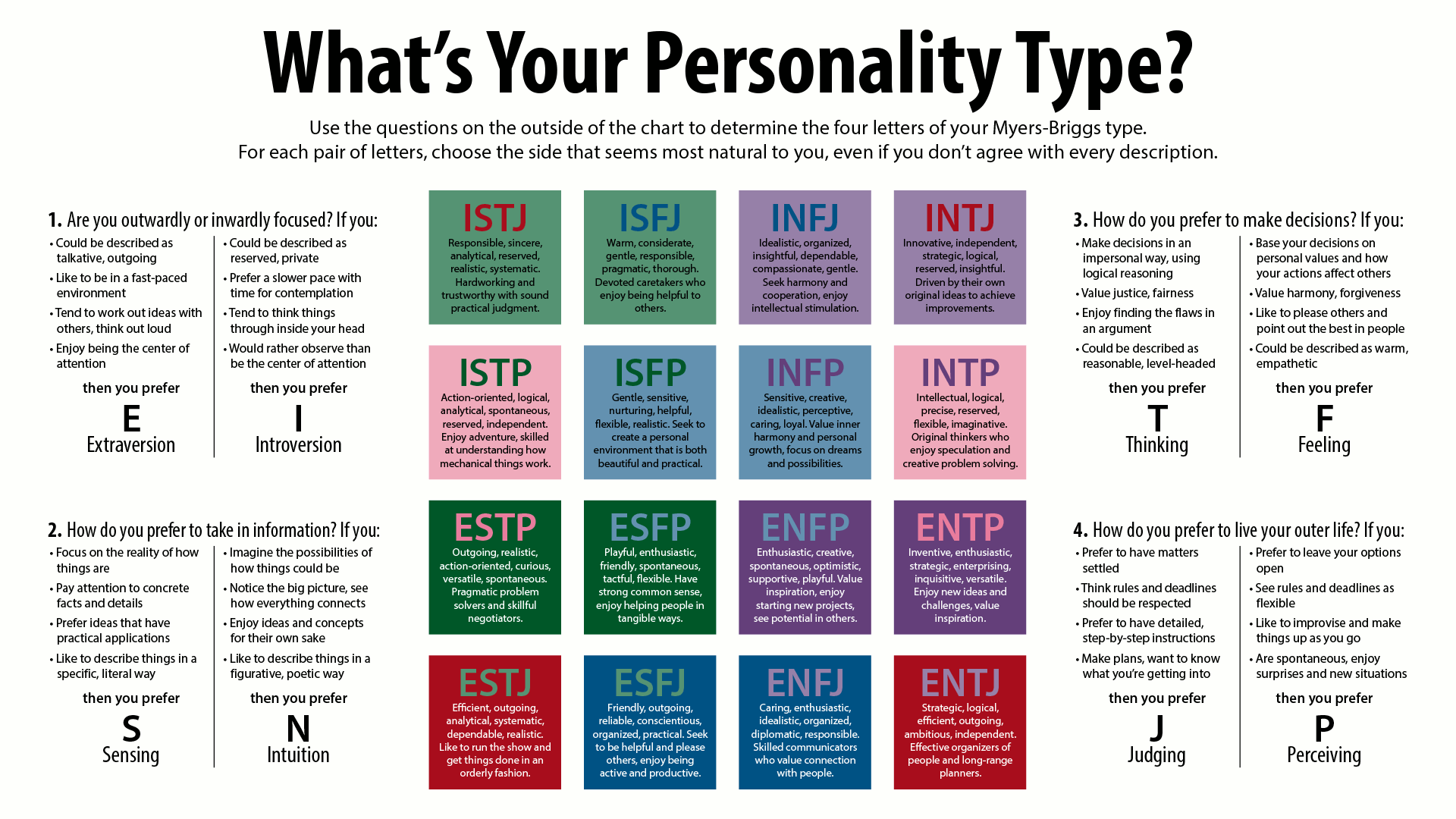
Personality types and exit games

Myers-Briggs types. Adapted from http://commons.wikimedia.org/wiki/File:MyersBriggsTypes.png, released under CC BY-SA 4.0.

Click for larger version.

Some people put a lot of stock in the Myers-Briggs personality types. Other people compare it to a modern-day form of astrology, with all sixteen types being desirable in their own way and people choosing to self-identify with the commentary from their specific type through a process of self-directed cold reading. I tend to be somewhat more towards the latter end of the spectrum – but then, as an INTP, I would say that.

That said, I did enjoy the 16personalities.com summary of the INTP type. It’s quite possible that if you’re a MB person, you might have been able to see it coming through in this blog; “They love patterns ((…)) people with the INTP personality type tend to share thoughts that are not fully developed, using others as a sounding board for ideas and theories in a debate against themselves rather than as actual conversation partners“. Guilty as charged.

I also enjoyed the graphic at the top of the Prelude Character Analysis page for the personality type, being a certain sort of logic puzzle. It probably shouldn’t be a surprise that I thought “I recognise that puzzle – and I like it”! It might also explain why this blog keeps a diffuse focus in puzzle adventures and tries to interest people in logic puzzle competitions.

So this post is principally directed towards those who do tend to give credence to personality typing, specifically the MB types; if this isn’t for you, there’ll be another post along tomorrow.

Do exit games tend to attract certain sorts of personality types? Do certain sorts of puzzles in exit games tend to attract certain sorts of personality types? Is there any social science, pseudoscience or just plain tried-and-tested anecdotal received wisdom over why certain sorts of puzzles – irrespective of the quality and originality with which that puzzle is implemented – tend to play well with the sorts of people who would pay money to play an exit game? Could sites do more to help people find which of the several games they offer they would most enjoy based on players’ personality types? (Right, that’s almost enough underdeveloped theories for one post, you lovely sounding-board.)

I also enjoyed reading this recent Escape Games Review post, hinting at an exit game, themed around the Seven Deadly Sins, where every team member started off in a sin-themed mini-room of their own which they had to escape solo before they could work together towards a group victory. Could there some day be an exit game where players had individual puzzles to solve that were tailored towards their personality types – either to play to their strengths, or to force them to overcome their weaknesses?

Jamming the odds and ends in

Jars of jam

Right behind these lovely-looking jars of jam is a jar of game jam. (Maybe it’s more of a preserve.) Specifically, it’s the Escape Room Game Jam held at MIT, probably the world’s coolest university, in the Boston area this weekend. It’s organised by the MIT Game Lab in affiliation with Red Bull; the link is clearer when it becomes available that teams will be creating escape room content “escape room based around a moment in a upcoming film”, with the film being DxM, the “second project from Red Bull Media House’s recently launched feature film division CineMater“. The boffo Variety magazine calls the film a “high-octane thriller based around the possibilities of quantum mechanics“. Sounds cool, though it’s not possible to measure precisely how cool without changing how cool it is.

This whole Game Jam is really exciting, not least because of the articles it has already generated. One of the co-writers and producer of the film, Joanne Reay, writes that “the next generation of Escape Room will offer a compelling narrative in which an understanding of the story-world delivers an added advantage and insight into the solving of the clues“. Quite possibly so; this site doesn’t believe there is a single future for exit games, but this definitely sounds like part of the future and one that a great many players would surely appreciate in their games. If it’s an aspect that is to be emphasised in this particular Game Jam then the results will be enticing indeed.

Additionally – and this is particularly interesting – Konstantin Mitgutsch, Affiliate Researcher at the MIT Game Lab, writes, advancing the state of the art, on the topic of turning escaping from exit games into a competitive sport. There’s definitely scope for expansion in at least a couple of ways here: first, how might these general principles be applied to other sorts of puzzle-based live adventures; second, how might Escape Room Malaysia’s Escape Run 2014 event compare in practice to the theory? (Are there any other events that might be compared? This site can’t think of any, but you may well know better…) Certainly if you were an operator thinking of running something yourself in the future, there’s the theory to consider.

The speakers at the Game Jam have remarkable sets of qualifications; the same page suggests that the event is set to be filmed. The designs produced are set to be released under a Creative Commons licence; hopefully, the filming will extend to the speakers and their talks will be released as well. If the content released does go on to be used in a pop-up game supporting DxM, then Red Bull will have probably done quite well in terms of getting considerable development expertise at the cost of enabling a single Game Jam – but the Game Jam material’s release will mean that the world at large will have done well from it too, and gratitude should be given to Red Bull and the MIT Game Lab for that.

A couple of other odds and ends outstanding: thank you to everybody who made a submission to the site survey released to celebrate its first birthday. There were more than twice as many responses as there were for the previous such survey (after a hundred posts) and it represents greater commitment to go and fill in a survey on another site, so this does represent progress. Particular thanks to those who offered additional commentary in the text box section, which will not be addressed here, but the responses were very much appreciated.

  • About a quarter of respondents are in the exit game business and another quarter have their own blog on the topic, so the proportion of “pure players” is just under a half. The suggests that no matter how many people visit the site just for the big map at the top and to find a site location, it takes quite a degree of commitment to scroll further down and read the blog articles, let alone respond to the poll.
  • Nearly 60% are more interested in exit game posts than anything else, nearly 30% are more interested in puzzle hunt posts than anything else, with some clicking both and some neither, which is fine; plenty of reason to keep things varied, but good to get such a clear indication of what you think the main attraction is.
  • The geographic questions were not so well-designed on this site’s part, but it looks like nearly a quarter of respondents are from Greater London, nearly a quarter from the North-West of England, just under 20% from the UK or Ireland but outside both hubs and just over a third from outside the UK and Ireland.

Finally, this site has captured a second quarterly set of live price data towards producing an estimated exit game inflation rate, and with rather a better idea than it had three months ago about what should be in the basket. Still far too early to attempt to quote a meaningful inflation rate, though, but the general trends based on very few data points are that London launch prices are varying at both the high and low ends compared to prior practice, and provincial launch prices are trending slightly lower.

Themed Thursday: Betrayal

Betrayal: the Kiss of JudasOh, dear. Even when this site tries to do a Themed Thursday, it comes out looking like a Mechanics Monday that missed the boat.

Themed Thursday is an exit game blog initiative whereby anybody who feels so inclined is invited to propose the contents of an exit game, in some way, shape or form, prompted by a specific topic. Last week, the topic proposed at QMSM for discussion this week was betrayal and has brought forward a thought from the back burner.

This will be a relatively rare supposition, but imagine that you are with an experienced team of exit game players and you have played most of the games at your favourite site. You’ve deliberately chosen which one, or ones, to leave because they’re advertised as being towards the easier end of the scale, and you fear that you won’t get your money’s worth. How can you make an easy game more of a challenge?

Many of you may remember The Mole, an originally Belgian constructed-reality game show in which a team take on a succession of challenges. However, one member of the team is the eponymous Mole and attempting to betray the others into not completing them successfully, while also attempting to keep their identity secret. The show has been running for a good fifteen series in the Netherlands and yet is as popular as ever.

Putting it together, is there a way to make an easy exit game more challenging by introducing a teammate who is incentivised to betray the others while keeping their identity secret? Here’s an attempt to codify one. Much as the individual challenges in The Mole only really worked in context of the overarching metagame, this needs some out-of-game structure to implement it, and here it has been posed in the reasonably familiar context of a gambling game with drinks at stake. As ever, don’t bet with money you can’t afford to lose (but if you can afford to play an exit game, you evidently do have some resources…) and this site doesn’t endorse drunkenness. Here’s a bombshell: I don’t even drink.

To play an exit game with a betrayer, you need at least a team of at least three players. Tear a sheet of paper into a number of roughly identical pieces, one more than the number of players. Mark one of these pieces with a cross and the rest with circles. Screw up all these pieces of paper and jumble them in a container so that it is unclear which one has the cross. Each player takes a paper, leaving one left over.

All players secretly look at the symbol on their paper, then keep hold of it until the end of the game. The player with the paper with the cross is the betrayer. (It is quite possible that there may not be a betrayer.) The team then play this ostensibly easy exit game and the betrayer’s aim is to prevent the team from succeeding in time, without being identified as the betrayer. Every player who isn’t the betrayer wants to try to convince the others that they are the betrayer.

Once the game is complete, every player individually votes as to who the betrayer was, then every player reveals their vote and their piece of paper. Any player who cannot present their own paper at the end of the game has lost and must buy the others a round of drinks. Trying to make other players lose their papers is slightly too dirty play for even this game… unless there has been acceptance beforehand that it isn’t. Voting for yourself, not voting at all, or any other sort of voting malpractice, are also offences that are penalised by buying a round of drinks.

If the team succeeds at the room, each player bets one drink against the betrayer as to whether their vote can identify the betrayer’s identity correctly or not. A correct identification earns the player a drink from the betrayer, an incorrect identification earns the betrayer a drink from the player – and the player must also buy a drink for whoever they incorrectly nominated as the betrayer.

If the team doesn’t succeed at the room, the bet is shifted in the betrayer’s favour. If more than half of the non-betrayers identify the betrayer correctly, the betrayer buys the others a round of drinks. (Exact 50% splits are broken in the betrayer’s favour.) Otherwise, every player whose vote does not correctly identify the betrayer must buy a drink for the betrayer and another for whoever they nominated – and a successful betrayer who isn’t voted for at all deserves to be bought drinks all night.

If the team doesn’t succeed at the room and it turns out that there wasn’t a betrayer at all, you’d better all just drink to forget…

Mechanics Monday: Could an exit game change the way you see the world?

Thoughts that rush through your headThe counterpart question to this is: has there ever been an exit game worth playing that didn’t change the way you see the world? Part of the appeal of many forms of entertainment is to help people feel good about themselves, and part of the appeal of puzzles, in whatever form, is that you can delight yourself by looking at a puzzle, thinking “I’ll never solve that”, then finding a way to solve it and prove yourself more capable than you thought.

Taking this further: is it plausible, and would it be cost-effective, that some charity, or some political party, or some cause might stage an exit game with the aim to deliberately raise a certain set of emotions in their players, or to change their misconceptions? Could an exit game set out to raise empathy with a particular group? All things are possible – a deliberate message to help people think about the human condition, as expressed through the medium of a live-action adventure with a time limit, might see the exit game as art rather than as craft. The challenge is whether one that could be made that worked on sufficiently many levels that it could be a stand-alone commercial proposition, rather than just an unusually participative medium through which to convey a message. Similarly, could there be such a thing as a flash (not Flash) exit game based on a recent news story? (Exit games based more generally on larger topics are well-known, such as “Cold War” stories.)

The history of art has been full of such position pieces, and the recent explosion in playable art has been no exception: arguable examples might include Blast Theory‘s Desert Rain, the National Theatre Wales’ Border Game, maybe Punchdrunk’s It Felt Like A Kiss. When the borders between different methods of expression are so blurred, it’s surely only a matter of time until someone comes up with something that identifiably has the exit game nature, or at least a decision mechanic to differentiate success from failure and provide an appropriate conclusion.

Let’s take an example. There’s no “this site” about what I’m about to say; this is a rare personal opinion. I am massively pro- migration, both immigration and emigration, more strongly so than any of the mainstream political parties in this country. (This is not really a subject appropriate for discussion in the comments, and unusual prejudice in this regard will be excised as I feel necessary. We’ll get back onto less controversial ground tomorrow.) As one starting-point, immigration has been massively positive for the exit game industry; furthermore, I conjecture that there is a positive correlation between exit games’ success in a city and that city’s willingness to accept and embrace migrants.

Without getting too partisan, and recognising that there are subtleties on all sides that cannot be included in a single paragraph, much of the current UK political rhetoric of the day is anti-immigrant, and some believe that recent immigrants are given immense practical advantages. It would be fascinating for an exit game to exist to provide a ludic version of the immigration experience – how difficult the language barrier is, how unforgiving the bureaucracy is, how expensive the process is, how disaffecting the attitudes of the unquestioning and misinformed are, how terrible and fearful the penalty that the enforcement officers are given to apply is.

Hopefully it could open a few people’s eyes – and stand up on its own merits as an exit game as well.

A random thought about how friendly things are

animal-friendsGratuitous cute shot? There’s a little more to it than that, even if only a little.

Apropos of not much, one pleasing observation relating to the exit game hobby is how little disagreement and rivalry it has seen. It’s not as if – at least so far – there has been a tendency for people to swear allegiance to one brand of exit game and disdain the others, or those who are fans of others. When so many hobbies tend towards the tribal, it’s a pleasure that there has not been a sense of trying to establish commonality through a shared enemy. It’s fine to play some games from one company and have a great time, then play games from another company and enjoy them as well, and nobody makes accusations of a lack of loyalty.

Even the companies’ owners are on good terms with each other, as far as this site has been able to tell. (Some countries have seen occasional malign practices, but no authenticated evidence of them having spread to the UK yet.) This site tends to believe that competition isn’t a zero-sum game and a rising tide lifts all ships. It’s also true that different businesses’ games aim to do slightly different things; it’s cool that different sites emphasise subtly different emotional experiences.

At a guess, there are two reasons for the lack of development of brand… loyalty isn’t the right word, jingoism may come closer. The first is that, broadly, people will only play each game once and develop their skill at exit games in general rather than one exit game in particular, so people don’t need to feel the need to validate themselves by promoting the skill they have developed at their specific game through promoting that game at the expense of others. The second is that exit games tend to attract those with a taste for the thoughtful, possibly at the expense of the self-aggrandising.

The hobby is all the better as a result of it!

Mechanics Monday: Tutorial Mode

Video game "Tutorial Mode"The excellent Shut Up & Sit Down board games review site sporadically releases podcasts; one of them discussed, among many other things, the question “What can board games learn from video games?” Good question, and the obvious parallel question runs “What can exit games learn from video games?“. Especially because, arguably, the answer could be the same.

Many video games have tutorial modes which briefly introduce the mechanics of the game, often one at a time, often by making players learn through doing them. Not many board games have such a tutorial mode and there is an argument that that could be as good, or better, a way to learn a game’s rules than a rulebook. So the question is: could the same principle be used by exit games? Could an exit game start with a tutorial mode… or, perhaps, a tutorial room?

A tutorial room might have as few as three or four puzzles and be designed to be beaten within low single digits of minutes. It could be extremely small and would be designed to be extremely easy to reset, if work is needed to reset it at all. It would help the less confident teams out so that they might hit the ground running when they go into the “real” room. It could help people learn what they’re required not to do for safety reasons. It would offer a perception of extra value. Lastly, it could be used to… not mislead, but explore design choices that were deliberately not incorporated in the real room.

Yesterday, this site discussed Dr. Scott Nicholson’s white paper, which has been updated since the last post with even more content. One particularly interesting suggestion in it is that hiding information by writing it in ink that might only be seen using a supplied blacklight is something of an exit game cliché in this day and age. Perhaps it might be appropriate to use this mechanic in a tutorial room and not actually in a main room, in that case.

On the other hand, given that exit games have thrived already without needing tutorial rooms, perhaps this is a solution in need of a problem. It may well be that part of the thrill is exploring the possibilities for the first time in your first room, being dropped into it and discovering for yourself what you can do. Perhaps a tutorial room could be an optional extra for the most marginal and least confident participants.

Returning to the overarching question of what might be learnt from video games, Dr. Nicholson also writes: Since escape rooms are hoping to meet the needs of many different player types, they should allow the players the ability to set their game mode. This will provide a way for a group of players to communicate to game staff what kind of game experience they are seeking. ((…)) Facilities with a human gamemaster can easily adjust the difficulty of the game experience by giving more frequent or more cryptic clues. ((…)) Another tip to take from videogames to enable a better player experience is to allow teams to switch to an easier mode while playing the game, so that if they are frustrated, they have a way to resolve that frustration before the game is over. There is some established practice in this regard: De Code Adventures of Canada offers a choice of three levels of difficulty in this regard, though it’s not clear whether the extremely sensible “jump down a difficulty level while the game is in progress” option is possible.

One way for an exit game to conclude, which wouldn’t be appropriate for many themes but could be hard to beat thematically for others which nod more directly at video games, would be for the countdown clock to count down to zero and then display the familiar “GAME OVER” motif. People would expect that. However, if beneath “GAME OVER”, there were to be a secondary message of “CONTINUE?” and then an additional short countdown timer, that would surely play with a few sets of expectations, maybe in just the right way!

An academic approach to exit games

scholarshipOne of the most interesting developments in the world of exit games over the last few months has been the scholarly investigation undertaken, as discussed, by Dr. Scott Nicholson, a Professor at Syracuse University in New York state. Dr. Nicholson has a long history in research with a focus (among others!) into different forms of play in the context of informal learning spaces such as libraries.

Late last year he launched a survey of exit game facilities, discussing the thinking behind his survey at his site Escape Enthusiasts. This has developed into a Google Group for discussion of the genre, with a counterpart Facebook group as well. The highlight has been publication of (at least an early version of) the white paper arising from the survey, which gets this site’s highest recommendation as a must-read for business owners and players who want to see behind the scenes.

One particular highlight of the white paper is the very neat way that it handles the claim that exit games date back to Silicon Valley in 2006. Additionally, it presents remarkably comparable prior art dating back at least a decade further to (as discussed) a series of games run at the LARP-themed International Fantasy Gaming Society’s “Once Upon A Con” events, which created a series of temporary rooms through hanging up tarpaulins and challenged teams to make their way through within time limits. It’s always an exciting possibility that there are other, similar games from decades ago that time has forgotten and that might present themselves again some day.

The demographic information that the white paper presents is fascinating, with the most robust attempt yet to compare self-reported practices in exit games around the world, with the best corpus of data yet collected from English-speaking Asia, as well as Australia, Europe and the Americas. This will inspire and inform those looking to set up their own new business, as well as those looking to develop their existing one. There’s plenty of information collected, too, about what might be found inside these rooms as well as who might be playing them, and about what just might be possible and practicable inside a room.

This site has always deliberately erred on the side of being relatively liberal in its focus with discussion of near-topic games such as True Dungeon, but did so on a vague sense of it being hand-wavily interesting. The white paper takes the scholarly approach that these things are not just interesting, but they are relevant because they have identifiable influence, even if at a remove or two, on the way in which the world knows exit games today and how it might know exit games in the years to come. Six different influences are identified and it takes a real breadth of ludic knowledge to pull them all together.

Jumping from the start to the end, the notion in the white paper that most excited this site is the counterpart way that exit games are put in context as a subset of live-action adventures. Look at it another way: if you look up an exit game on TripAdvisor, it’ll be ranked in the context of “Fun Activities and Games”, and it’ll compete against – for instance – paintball, go-karting, casinos, laser tag and soft play. Is this a rag-bag assortment or are there lessons to be learned for exit games from some of them? Not so much from casinos and probably only tangentially (in the briefing-with-instructions, activity, debriefing schedule) from go-karting – but, as for the others, maybe there’s more in common than you think. If people like laser tag because they want to be inside a video game like Halo, perhaps they like exit games because they want to be inside a video game like Myst.

This site enjoys reading about live-action adventures, though sometimes hiding behind the sofa. This site isn’t going to become a live-action adventure blog, though. (Laser tag, although it will always be cool, is moving in a direction that this site does not appreciate so much; it’s becoming much less Half-Life and much more Call of Duty. No thanks.) Additionally, this site has always considered interactive theatre to be on the border of its remit, with playable theatre (if that’s a term anybody else uses, noting the many meanings of the word “play”…) definitely on-topic.

Putting it all together, this site loves puzzle adventures; they might involve being in a room, they might involve being in a puzzle hunt (whether online or in person), they might involve being part of a competition. However, it’s much easier for a puzzle competition to feel like an adventure in your head if there is some structure, context and persistence to them, rather than just being one-off tests – for instance, the adventure of being part of a team and helping your team advance through your progress. If this breadth of approach isn’t to your taste, other blogs are available. You should start your own; this site would link to it!

Looking forwards, Dr. Nicholson will be the keynote speaker at an upcoming “escape room Game Jam” held at MIT in greater Boston. Teams will have (nearly) 48 hours to “create puzzles and games to be played within a pop-up escape room (…) based around a moment in an upcoming film“. (It’s not clear which film; a film will be screened at the start of the event, so that would seem likely to be the inspiration.) Intriguingly, this is being held in association with Red Bull and winning participants get an expenses-paid trip to Comic-Con 2016. Not bad! The event has sold out, but will be filmed and the material generated will be made available under a Creative Commons licence.

Perhaps, in time, the world at large might get to play the winning, or a composite, pop-up exit game when the film gets a wider release; it wouldn’t be the first film to have a pop-up exit game associated with it – the one associated with The Purge: Breakout showed what might be possible. It’ll be extremely interesting to see if anything ever develops as a consequence of this Game Jam and to follow additional developments as they arise.

Exit games have taken off so rapidly that the world can hope to attract attention from all sorts of different sources and to be intepreted in all sorts of different ways. The exit game world should be very grateful to have someone who has professional academic expertise casting an eye over it, as well as us amateurs; that might sound dismissive, but it’s intended as a compliment – remember, an amateur is someone who does something for the love of it.

(Unrelatedly, if you haven’t done so already, please would you consider filling out this site’s survey? Thank you!)