“And STILL… undisputed championofthewooooooorld…”

Ulrich Voigt, ten-time World Puzzle ChampionThe photo above, taken by the Japan Puzzle Federation, is of Ulrich Voigt, shortly after winning third place in the World Puzzle Federation’s in-person final of their year-long GP competition. This was just a warm-up for him, preparing his defence of his individual title. The previous post saw him listed as number one seed going into the play-offs.

The quarter-final saw finishers numbers seven to ten compete over three puzzles, for a single spot in the semi-final, with the lower-ranked finishers suffering late starts relative to the seventh-placed finisher by way of a handicap to penalise them for their lower finish. Bram de Laat of the Netherlands started the quarter-final first, by virtue of his seventh place finish, Zoltan Horvath of Hungary started second for finishing eighth, Japan’s Kota Morinshi finished ninth and so started third, and the USA’s William Blatt started fourth, having being promoted to a tenth-place finish upon appeal. (Previous tenth-place finisher Roland Voigt responds very reasonably.) The first puzzle, a Slitherlink (a.k.a. Fences, Rundweg etc.) was probably the one that had the biggest impact in the quarter-final; Kota Morinshi overtook the two previous starters and never looked back, even after having to erase a big chunk of his third puzzle. Kota finished the quarter-final first to reach the semi-final, and the potential double championship remained on!

So, in the semi-final, Kota Morinshi started some time after sixth-placed finisher Peter Hudak of Slovakia, somewhat longer after fifth-placed finisher Hideaki Jo of Japan and even longer still after fourth-placed finisher Palmer Mebane of the USA. In Palmer’s own write-up, he talks about the five puzzles he faced. He points to an unusual technique that he used to crack the Suguru puzzle, on his way to defend his fourth-place finish and qualification for the final.

Palmer had a 4’20” penalty to make up, with third-place finisher Florian Kirch of Germany suffering a 3’40” hold and second-place finisher Ken Endo of Japan having to wait 2’49” until after first-placed qualifier Ulrich Voigt of Germany started his final. This was longer still at seven puzzles: in order, Battleships, Area 51, Kakuro, Nurikabe, Unequal Length Maze, Neighbours, and Masyu. Mebane spotted a quick constraint on the 3-length ships to make up much of the time disadvantage on the Battleships puzzle, and was fast on Area 51 and Kakuro despite a minute-long penalty for a wrong answer on the second and 30 seconds struggling with a false solution to the third. After catching up further on the Nurikabe, Palmer writes:

(…) Unequal Length Maze is a fiddly Erich Friedman type without a lot of logic in it. An odd choice for a playoffs. Apparently this one went really poorly for Ken Endo, leading to his eventual 4th. In contrast, I saw a way to include a path pattern I often see in the solutions for these and finished it in 15 seconds. I was rather incredulous at this, my invigilator David McNeill was moreso (…) and Josh Zucker from the USA B team said it was his favorite solve of the championship.

Palmer made up more time still on the tricky Neighbours and final Masyu, so had come back a long way from his 4’20” initial deficit. Not quite far enough, for Ulrich Voigt had finished 22 seconds earlier to claim his tenth world championship. (This is the first time he’d won three in a row, and the first WPC “threepeat” since Wei-Hwa Huang bowled a metaphorical turkey in 1997-1999.) Florian Kirch was also making up time, finishing within a minute as well to take the third step on the podium. Full results to follow shortly when available. Congratulations to all the play-off participants, and to the top-placed teams as well.

The whole concept of a play-off for the finals remains slightly controversial, though it has been well-established since 2000. There is scope for criticising the extent to which the results of the first two days of competition are, arguably, close to thrown out when the result of the handicapped fifteen round decide the overall result. It’s almost a made-for-TV finale before the event has started to attract TV coverage. There have been a variety of play-off formats used over the years; this year’s was relatively well-received, for making the headstarts relatively large while keeping the solving interesting. It’s interesting that Palmer Mebane fairly explicitly targets finishing first before the play-offs over finishing first in the play-off, and he’s not alone in that opinion. Nevertheless, there are no realistic signs of play-offs being removed from championship consideration in future years.

Stretching back to last century, perhaps American Gladiators is to blame?

Finals day at the World Puzzle Championships

Europe's "The Final Countdown" single coverTwo days down and one day to go at the World Puzzle Championships! Arguably today is the single biggest day in the world puzzling calendar.
Usual source Akıl Oyunları points to a scoreboard photo taken by Rejtvényfejtők Országos Egyesülete, which I believe is the Hungarian puzzle organisation. Germany are leading the team competition with a single round to go from Japan, by almost a thousand points. Germany B are in unofficial third place, but ineligible for the podium; in the official third place is the US team, but are only barely ahead of Slovakia in fourth place. There’s a long gap between the first two and third place – so, barring a remarkable disqualification from the final round, it’s practically head-to-head between Germany and Japan for the title. The fifteenth round, the final one before the individual play-offs, is a purely team contest:

This team round consists of three phases. The first two phases take place in one session, and the third and final phase takes place in a second session, with a break before it. In the first phase, which covers puzzles 1-4, each team will be seated at a table and will be asked to solve 4 separate paper puzzles. (…) In phase 2, which covers puzzles 5-7, the players move counters according to given rules in a series of steps. When the team are satisfied they have found the final position of each counter, they should mark the locations with the given stickers.

Bonus points will be awarded for teams who finish all 7 puzzles correctly in the allotted time, as
per the other team rounds. In addition, the first 8 A-teams to submit a correct set of solutions for both of the first two phases will qualify for the third and final phase. (…) Teams that successfully complete the final round will be awarded further bonus points according to their ranking position: 1st=2800 points, 2nd=2000 points, 3rd=1400 points, 4th=1000 points, 5th=700 points, 6th=500 points, 7th=350 points, 8th=250 points. In the final phase, the team players will themselves act as counters moving around a large grid on the floor, with each player playing the role of one of the four counters.

So Japan have a fair bit to do in order to catch up with Germany. If Japan complete the final round correctly and Germany don’t, that will be enough, but this seems unlikely. If Japan complete the first two phases more than three minutes more quickly than Germany, then they’ll be within 800 points of Germany and just need to win the third phase outright. However, if neither of these is true, barring a German meltdown, Japan will need to beat Germany in the third phase by at least two places to overtake them. Slovakia are within a couple of hundred points of the USA, so overtaking them to reach the podium looks like a distinct possibility.

The individual play-offs take place this afternoon, with the ten finalists being, in descending order of score:

  1. Ulrich Voigt, Germany
  2. Ken Endo, Japan
  3. Florian Kirch, Germany
  4. Palmer Mebane, USA
  5. Hideaki Jo, Japan
  6. Peter Hudak, Slovakia
  7. Bram de Laat, Netherlands
  8. Zoltan Horvath, Hungary
  9. Kota Morinshi, Japan
  10. Roland Voigt, Germany

The top-placed UK finisher was Neil Zussman, who missed the play-offs by fewer than fifty points when Roland Voigt overtook him to take the tenth spot in the last individual round. So close…

More later. This site doesn’t normally do multiple posts in a day, but finals day is an exception!

Friends in high places

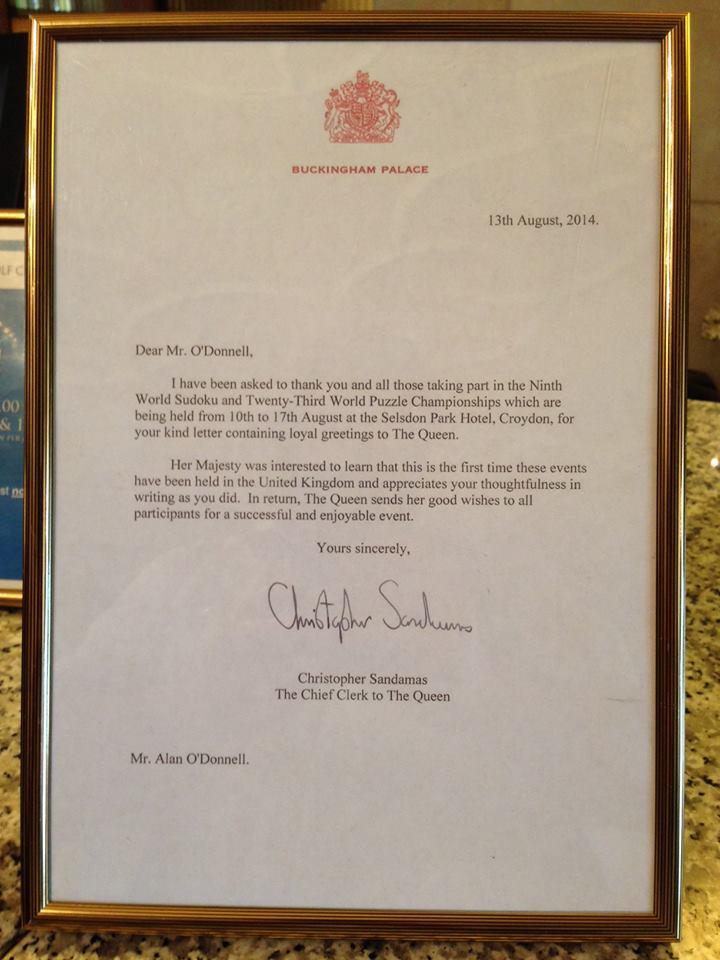
Letter from Buckingham PalaceOne of the star guest attractions at the World Puzzle Championship is the above letter, sent in response to a letter informing Her Royal Highness Queen Elizabeth II of the event’s existence. Probably most of the event attendees have their own photos of the framed letter; credit Akıl Oyunları for that particular photo, that does well at avoiding the glare of reflection from the frame. (Unusually for this web site, click on it for a closer look.)

Akıl Oyunları also takes the credit for recent photos of the World Puzzle Championship scoreboards after five rounds: the team scoreboard has the German team narrowly overtaking the Japanese team after round five (and the USA team being fought hard by the German B team) though there has been some nip-and-tuck in the battle between them, and the individual scoreboard shows Germany’s Ulrich Voigt starting to pull away from the field.

For further live updates, keep following Akıl Oyunları’s Facebook page and perhaps also the German-language “Live from London” thread on the Logic Masters Germany page. The Canadian puzzle team weblog is being frequently updated as well, as is Palmer Mebane‘s weblog. On Twitter, English-language discussion was tagged #worldsudoku for the world sudoku championship and is being tagged #worldpuzzle for the world puzzle championship. If you know of other sources, please post them in the comments below.

The in-person final of the World Puzzle Federation’s GP competition was last night. The “Live from London” thread referred to above had the play-by-play and the Japan Puzzle Federation have a photo of the scoreboard. It must have been great fun to watch the scoreboard be updated in real time, let alone watching the competitors solve the problems. Congratulations to Hideaki Jo and Kota Morinshi of Japan for overcoming their slight time penalty, arising from performance in the online rounds, to take first and second ahead of Germany’s Ulrich Voigt.

In exit game news too exciting to wait, Escape Quest is a site under construction, expected to open in November in Macclesfield, Cheshire. The site has a gorgeous little trailer video that’s rather fun. You can sign up in advance, with an opening discount promised, and a little impudence and investigation (for would you expect less?) reveals an address, so there can be a pin in the map. This site wishes Escape Quest well and looks forward to reading more from them!

Sudoku’s coming home

sudoku japanese script logoThe history of sudoku is a long story – or, at least, a long-distance story.

Magic squares date back to China and were generalised by the great Swiss mathematician Leonhard Euler. A hundred years ago, French newspapers published some puzzles that bear very considerable similarities to sudoku, if you squint. The birth and infancy of sudoku as they are generally known today is ascribed to Howard Garns, and it’s certainly true that there have been “Number Place” puzzles in Dell Pencil Puzzles and Word Games magazine since 1979. However, the puzzle only really grew up after it started being featured in the great Japanese puzzle company Nikoli’s monthly communications from 1984. Taking the analogy further, New Zealand’s Wayne Gould adopted the puzzle and introduced it back to the English-language mass market, starting with The Times of London in 2004. It has spread around the world from there.

Nevertheless, it’s probably fair to say that sudoku is largely considered a Japanese puzzle; certainly one of its Japanese names has broadly stuck, rightly or wrongly. This is the sense in which the ninth World Sudoku Championship represents something of a homecoming, for the individiual winner was Kota Morinishi of Japan, the first time the competition has been won by a Japanese solver. (Kota had finished second for each of the last thee years, so this does not come as a big surprise.) The individual results have been posted and the Independent has a report with a little colour about the play-offs. The team results will surely follow very soon.

Clearly Kota is in hot form and will be looking to do the double when the World Puzzle Championships start tomorrow, also in Croydon. Kota finished eighth in last year’s WPC, but also finished fourth in the World Puzzle Federation’s Puzzle GP series held over the year, so he’s definitely got a chance. Nobody has done the double before, though; the closest anybody has come is Dr. Thomas Snyder of Grandmaster Puzzles. Dr. Snyder won the World Sudoku Championship in 2007, 2008 and 2011, and finished second in the World Puzzle Championship in 2007 (and third in 2011). You have to imagine that Kota will be there or thereabouts in the puzzle championship, though there are a great many strong contenders trying to keep him from the title, not least his Japanese teammates.

Nevertheless, this site chooses to consider it a good sign for its prediction of Japan to win only its second ever team championship…

((Edited to add:)) While they’re not up on the web site yet, someone has posted a photo of the top of the team scoreboard. Congratulations to Japan for winning the team competition, by a narrow margin from Germany and China. As well as no individual ever having done the sudoku-and-puzzle double, no country has ever done it yet either – at least, until now!

The World Sudoku Championship is in progress

World Sudoku CHampionshipDay one of the World Sudoku Championship has seen a great degree of mass media coverage. The Independent on Sunday previewed the event, the Telegraph also previewed the event on the Sunday and then carried early event coverage on Monday, with a great many fun quotes from competitors. The event even made the 6pm national BBC radio news broadcast – skip to 27’35” to 29’39”.

The Guardian also had a piece, relaying gloom from the British team. (I did particularly like one of the readers’ comments, though, and suspect I may steal it to use heavily over the next ten years: I went to a sudoku championship once, but it was only to make up the numbers.) Further afield, Le Monde were very charming about the event, in French, and I would bet that the Chinese media covered the event heavily as well, for they are the favourites. The volunteers are busy marking papers, but some coverage from day 1 has been published.

I also enjoyed this witty comment on Twitter: Croydon hosts World Sudoku Champs. What will the legacy be? Will a generation be inspired? No 9-storey 9-room towers of dedicated infrastructure required, but more people trying out for the UK sudoku and puzzle teams next year than this year would be a great result.

It’s World Puzzle and Sudoku Championships week

World Puzzle and Sudoku Championships logoThe World Puzzle and Sudoku Championships are happening in the UK for the first time this week at the Selsdon Park Hotel and Golf Club, just south of Croydon. The ninth World Sudoku Championships are already underway (see, for instance, a preview in the Independent on Sunday) and will crown their World Champion tomorrow; the 23rd World Puzzle Championships start on Thursday and run until Sunday Saturday ((ETA: Thanks, Ken!)).

This site is particularly excited about the World Puzzle Championships and really enjoyed reading the competition’s Instruction Booket, admiring the inventiveness and ingenuity of the puzzles that – frankly – are way out of our league. Nevertheless, looking at the registration list, we can attempt to consider the championship as the sporting event that it is and make some predictions for the sake of them having proved wrong soon.

A starting-point for treating the World Puzzle Championship as a sport is the Wikipedia article, but the motherlode is Tim Peeters’ site. You can get the results from the three most recent championships within the World Puzzle Federation‘s newsletters for 2012, 2013 and 2014, each with the results from the previous year’s championships.

This year there are 22 nations who have sent national teams of four solvers to the World Puzzle Championships, though nine nations additionally have sent “B” teams and there are also nine “United Nations” transnational teams. (In total, there will be 29 nations represented at the World Puzzle Championships.) This makes this year’s event relatively large to those of recent years, though not exceptional.

The 22 years of the World Puzzle Championship have only seen four different national teams win. The Japanese team won one, the Czech team won three, the German team have won four and the team from the United States of America have won the remaining fourteen. The US team has a 22/22 record at finishing in the top three places, the German team have finished on the podium 12 times in the last 14 years and the Japanese team’s unbroken run on the podium stretches back nine years. The Czech team were on the podium seven times in the first ten years; the Hungarian team have made four podium appearances and the Dutch team three, including two second places. Other teams on the podium have included Argentina, Belgium, Canada, Croatia, Poland and Turkey.

The US team return three from last year’s championship winning team, headlined by four-time champion Wei-Hwa Huang and 2011 champion Palmer Mebane. William Blatt made it to the top ten last year to make the play-offs, as well. The change is that Thomas Snyder, four times on the podium for each of the World Puzzle and Sudoku championships (three times on the top step for Sudoku) has been replaced by MIT’s Anderson Wang. Big shoes to fill, but it would be a major surprise not to see their 22/22 streak on the podium become a 23/23 streak. Can they make it onto the top step again? Quite a few teams will have something to say about it.

Ken Endo described the Japanese selection process in his blog; the Japanese team deliberately include one first-timer in their World Puzzle Championship line-up, so long as they make the top ten of their domestic qualifying contest, and fill the remaining places with the top three outright. This year’s new blood is Yuki Kawabe, backing up Hideaki Jo (who has finished in the top six for six years in a row), Kota Morinshi (improving from 26th to 11th to 8th over the last three years) and Ken Endo himself, who was top among the B-team solvers last year. Hideaki, Kota and Ken took second to fourth in this year’s WPF GP and Yuki was eighteenth. Several teams have two world class solvers and a few have three, so a large part of the destiny of who will win the world championship may come down to the strength of the fourth team member. Judging by the WPF GP results, Japan may have the strongest fourth member.

The German team starts with Ulrich Voigt, bidding for his tenth title. His nine championships go back as far as 2000, and he’s not yet won three in a row – so a title this year would represent that distinction for him. He is well supported by his brother Roland, who finished second in 2002 (to beat Ulrich!) and who also has a sixth-place finish in 2011, when he hasn’t been involved running the German selection process. Florian Kirch finished tenth in 2009 and has three other top-20 appearances, and Martin Merker was very competitive as a guest last year, backing it up with 20th in the WPF GP as well. Very likely to be there or thereabouts once again.

If this site is going to pick a team to make it onto the podium for the first time, it will be brave enough to pick Slovakia, who finished fourth in 2013. They return all four team members from last year; Peter Hudak made it to the top ten and took part in the play-offs and their other three members were competitive, finishing in the top 27 official places. Definite contenders, as experience counts a great deal. Similarly, the Czech team return all four from last year, and are likely to be there or thereabouts. The Dutch team feature Bram de Laat, ready to make a break for the podium after going 9th-7th-4th in the last three years, and two-time World Champion Niels Roest makes a return. Rick Uppelschoten makes his ninth appearance, a top-20 solver more often than not and Annick Weyzig has two top-40 places, so they too have definite outside podium chances. The Hungarians include 2007 champion Pal Madarassy and 2012 fourth-place finisher Zoltan Horvath, so are well in the mix.

What about the home team? Neil Zussman and James McGowan enjoy a friendly rivalry at the top of the order, both finishing well in the top 20 last year, and both in the top 10 of the WPF GP this year, showing their form. They’ve both been red hot on qualifying tests in the past, not just winning the national title but beating all global competition in the UK Puzzle Championships of the last two years. Both will strongly fancy their chances of making it to the top ten and the play-offs this year. Steven Barge has three past WPCs to his name, finishing top of the UK solvers twice, and Thomas Powell came about half-way last time. It’s not clear that there is such a thing as “home advantage” in puzzle championships – indeed, dragging attention away from some of the top solvers to be on the organisational side must be a disadvantage, and the Dutch and Hungarian sides look stronger than they were last year – but last year’s sixth place for the UK team showed what is possible.

This is the point where the Canadians, French, Polish, Turkish and so on curse this preview for not highlighting them. It would be a delight for any of them to take this as inspiration to prove this preview wrong, especially if I’ve swept them aside into just the “and so on”!

This World Puzzle Championship is trying something different on the Sunday Saturday by featuring one final team round with very considerable bonus points on offer to the fastest finishers, almost analogous to the play-offs that have long been a part of the individual competition. Indeed, the fastest eight teams will get a second round of puzzles, in which the team members themselves will move about the life-size grids to demonstrate their answers rather than just putting dots on pages. My suspicion is that this final round will be crucial as to determining the overall outcome of the championship, and it may well be that at least two or three teams are in with a realistic chance at the start of this final round. It’ll be exciting!

For the sake of punditry, if you make me pick a single winner… it would be safe and predictable to pick the USA as winners for a fifteenth time, but I think 2014 will be the year Japan win their second world championship.

Bath Escape

Bath Escape logoIt seems a reasonable generalisation that if you’re reading this blog, there’s a good chance that you enjoy discoveries, particularly pleasant surprises. It’s always a thrill to find a new exit game of which this site was previously ignorant. There was an even bigger pleasant surprise recently when Essa got in touch to introduce Intervirals, a fan blog about room escape games. (Seems like a good idea!)

Essa’s site has been running since February this year, so this site happily tips its cap to acknowledge Intervirals’ seniority. It’s full of posts crammed with excellent links, taking a global view more effectively than even the Around the World posts made here, plus information about coupons and discounts analogous to this site’s Dealwatch posts. Most impressively at all, Intervirals has national exit game directories for fifteen European countries and fifteen other countries from around the world. That’s dedication and bravery for you, and Intervirals goes straight into this site’s blogroll and links page.

There’s also considerable resourcefulness and talent; Intervirals knew about Bath Escape, which has been open since mid-June when word had not reached this site. (How many more similarly covert exit games are there out there? The more, the merrier!) This is a great find because it’s a very interesting proposition.

The site features two exit games called Six Locked Doors and The Haunted House Escape. The first of these sounds like an unusually high quantity of doors, making it quite a big game as they go; quoting an ideal team size of 4-5 (and a maximum of 6), this game has a time limit of 75 minutes, pointing to a meatier challenge than most. Teams of 3-4 are recommended to go for the 60-minute Haunted House Escape instead.

However, the site also really cleverly features walking tours of Bath, and these take a form much more like a sequential puzzle hunt, where location-specific puzzles direct you to your next destination and the next part of the story. These can be played by teams of 2-6 and are estimated to take 2-3 hours; it may well be that they’re not against the clock at all. The first two games are Case No. 219, exploring Bath landmarks, and Victoria’s Secret, centred around the Royal Victoria Park, taking in the Botanical Garden and the Royal Crescent.

This site is not familiar with anybody else taking exit games and puzzle tours together, but it’s a smart pairing – if you like one, there’s a very good chance you’ll like the other, and there’s something to do on both indoor and outdoor days. The fact that both of them converge at the Princes’ Treasury tea room also makes it sound like a really well-integrated facility. (Check out the tea room’s crepe menu from October! Mmm…) Don’t think too hard about the pronunciation here, but what could be finer than an escape and a crepe?

All the news from the world’s exit games

Newspaper iconThe previous post contained a collection of links with exit game news from Europe; today’s news collection looks a little further afield.

Yesterday, this site linked to this German live escape games blog, with a map linking to known sites around Europe. With a tip of the hat to Scott, a site about online escape games is attempting to collate a global live escape game map. Ambitious, but brilliant! There’s only one post to the site’s blog so far, but this site looks forward to others. A rising tide lifts all boats. (Spoiler: something very cool in this regard very soon.)

One of the most interesting exit game developments in the US is Trapped In A Room With A Zombie, remarkable for already having a dozen locations across the country, East to West, North to South. The creator, Marty Parker, is prominent and fascinating in mainstream publication interviews; his take on his own segment of the industry in Art Attack Philly is well worth a read to give you a sense of his perspective on his own cottage industry, which you can put into context by reading other interviews from newspapers in Columbus from February and Boston from July.

Lastly, across the border to Canada – specifically, the province of Ontario. Scott, to whom we referred above, curates an amazing Ontario exit games catalogue, and the wide availability of games also attracts local press interest. (Why has Toronto evidently become a hub in the same way as Budapest and Beijing? Professional enigmatologist Stacy Costa, a SCS Instructor at the University of Toronto, had this to say.) It’s the location for the Canadian operation of the original Real Escape Game, as discussed at Motherboard, with The Star taking a wider look at the popularity of the genre across their area.

With so much interest in exit games, it would appear logical that there could be the demand for other sorts of puzzle events in the Greater Toronto area. Perhaps this might be another conurbation in which the likes of DASH and/or Puzzled Pint might take root. There aren’t yet puzzle hunts in quite the way they are known elsewhere, as far as this site can tell, but a spy-themed game seemed to have quite a few similarities (though, sadly, the domain discussing the event appears to be no more) and the FISH Scavenger Hunts annually held in Toronto, and Vancouver, also sound spectacular and relevant.

Toronto does have its own sort of hunt that may be all its own. Tip of the hat to the German Live Escape Games blog for this one, and it’s the sort of story that makes you check that you’re not reading a satire site by mistake. The Simcoe Reformer suggests that there have been scavenger hunts in Toronto where the prizes to be found are, well, cannabis. A larger event planned for September promises to put the “pot” into “jackpot”, or perhaps the other way round.

This might sound like a plot from a Cheech and Chong movie, and it might be the plot of one. The Canadian stereotype of politeness, legality and good order holds firm, though. Participants are not invited to dig up random leaves and take a chance at smoking whatever they find; instead, the prizes are vouchers. In order to claim your prize, you have to be one of the 11,000 locals with a medical marijuana licence already.

Rob Ford would surely approve!

All the news from Europe’s exit games

Map of part of EuropeIt looks like Iceland, at least, is missing from the above map. This site will apologise for this omission as soon as Iceland gets its first exit game, which probably won’t be too long. Let’s start by sweeping up a few stories from around Europe; next, we’ll feature a few stories from further afield.

Live Escape Games is a German weblog which attempts to provide a map of all known exit games from around Europe. (You’ll find a link to it on this site’s blogroll.) It’s interesting to see a dozen of them identified from around Germany, plus another 23 from around the rest of Europe. It’s always difficult to know whether there are others not yet known – and attempting to cover the whole of Europe is delightfully ambitious, not least because of the language barriers – but it will probably get easier over time. The wonderful granddaddy site of them all, exitgames.hu, reports 81 different sites across Hungary, though no map.

Another addition to the family is exitgames.ro of Romania, with gorgeous graphic design. It details a site in Oradea, just on the Romanian side of the border with Hungary, and a site in Timișoara, rather closer to the border with Serbia. It also features what this site would be willing to bet is the premiere Romanian-language blog about exit games, linking to us with a heartbreakingly gorgeous graphic.

There’s also a corking English-language article on budapest.com about the apparently language-neutral Sweet Escape exit room in the city. Supposedly many of Budapest’s exit games are language-neutral, though arguably that limits the scope of the puzzles that can be offered there. The article is worth reading for a number of cute stories, of which this is perhaps the one most of interest to this site:

there are fan clubs which are organized with one goal in mind: to visit and solve every Escape room they find. There was a team among our players who already had visited 17 other rooms before.

If you’re in such a club and you find this article some day, please say hello in the comments section below – and if such a club decides to bag the games of the UK and Ireland for their collection, bring it on!

The “Top Secret” one-day Cryptic Treasure Hunt in Essex

A logo for the location where the puzzle hunt took placeMonths ago, this site previewed the “Top Secret” One-Day Cryptic Treasure Hunt that happened last Saturday. Here’s a second-hand report of what happened.

The event took place at the so-called Secret Nuclear Bunker at Kelvedon Hatch in West Essex, just outside the M25. The site is a tourist attraction now, but has a history of having played a number of different roles in civil defence over the years.

One challenge that puzzle hunt organisers face is trying to set potential players’ expectations appropriately, not least to give people the right information to judge whether this is the right hunt for them or not. (Not that there are a great many hunts to choose from! At least, not yet…) It’s a particularly difficult challenge for a one-off or first-time hunt, as a good technique is being able to point to (at least an account of) a comparable hunt. This hunt had its original flyer (.pdf file) that cunningly contained hypertext (marked “Top Secret!”) that linked to a teaser that give a hint to the location.

The hunt offered the teams the chance to attempt to retrieve clues from within a variety of rare, valuable and intricate mechanical puzzle boxes, construction puzzles and the like. These clues would give hints, in various media, towards decoding a metapuzzle to find the exit of the bunker section of the hunt.

One particularly popular and clever puzzle saw the teams exploring a recreation of the nuclear bunker within Minecraft – upon finding a particular object hidden in the virtual world, teams were directed to find a clue hidden in the counterpart location in the physical world.

Outside the bunker, there was a later clue requiring use of part of the ropes course on site, and the conclusion of the hunt saw a very visual demonstration of where Stephen Miller, who organised the hunt, got his Pyro Puzzles brand name from. You can see how atmospheric the location was and judge the reactions of the players from this collection of photos from the event.

There are many different parallel puzzle hobbies in the UK and Ireland, often with little overlap – the armchair treasure hunt hobby, the logic puzzle contest hobby, the mechanical puzzle hobby, the DASH-and-Puzzled-Pint hobby, the exit room hobby, and so on. Part of the impetus for this site is to try to bring elements of these hobbies together and help people who know they like one to find other hobbies that they may enjoy as well.

It was clear that most of the entrants to this hunt came from one particular background. The extremely positive social media response goes to show how well-received the hunt was and how well the hunt succeeded in its evident aims.

Many thanks to organiser Stephen Miller and team for putting the show on; it’s clear that a great deal of effort goes into running any puzzle event. This site notes the imminent release of his Fire mechanical puzzle, the start of the Elemental series, and looks forward to further developments.

was a blog about puzzle hunts, puzzle games, escape rooms and more