Tag Archives: business

The League Table: end of April 2015

3-D bar chart with broadly increasing trend

This is the thirteenth instalment of an occasional feature to act as a status report on the exit games in the UK and Ireland. On its own it means little, but by now hopefully it can be part of the basis of a survey of growth over time.

The Census

Category Number in the UK Number in Ireland
Exit game locations known to have opened 57 5
Exit game locations known to be open 53 4
Exit game locations in various states of temporary closure 2 1
Exit game locations known to have closed permanently 2 0
Exit game locations showing convincing evidence of being under construction 6 0
Exit game locations showing unconvincing evidence of being under construction 5 0
Exit game projects abandoned before opening 2 0

The term opened should be understood to include “sold tickets”, even when it is unclear whether any of those tickets may have been redeemed for played games; the definition of location should be understood to include outdoor locations, pop-up/mobile locations and component parts of larger attractions that are played in the same way as conventional exit games.

This month’s count includes a location that opened in December but which this site did not find out about until a week or so ago, which is why the wording states “known to have opened”. There might be others open that haven’t made it onto this site’s radar, but hopefully not. There is at least one location where this site is unsure if it has opened or not – but as there is no obvious, conclusive social media push and there has been no response to e-mail, this site is erring on the side of “not open yet”. Two more sites are expected to open on May 1st and so have not been included in these figures but will be included in next month’s figures.

The Report Card

Site name Number of rooms The reviews
Site name Total number Different games Find reviews Quantity Quality
Adventure Rooms 1 1 TripAdvisor Few Brilliant reviews
Agent November 2 2 TripAdvisor Some Brilliant reviews
AK Escape Room 1 1 (TripAdvisor) No Early reviews
Bath Escape 2 2 TripAdvisor Some Brilliant reviews
Breakout Games Aberdeen 3 2 TripAdvisor Few Brilliant reviews
Breakout Liverpool 3 3 TripAdvisor Few Excellent reviews
Breakout Manchester 7 6 TripAdvisor Loads of Brilliant reviews
Can You Escape 1 1 TripAdvisor Some Brilliant reviews
Cipher 1 1 TripAdvisor No Early reviews
Clue Finders 2 1 TripAdvisor Some Brilliant reviews
Clue HQ Blackpool 1 1 TripAdvisor Some Brilliant reviews
Clue HQ Warrington 3 3 TripAdvisor Loads of Brilliant reviews
clueQuest 4 2 TripAdvisor Tonnes of Brilliant reviews
Crack The Code Sheffield 1 1 TripAdvisor Few Brilliant reviews
Cryptopia 1 1 TripAdvisor Few Brilliant reviews
Cyantist 1 1 TripAdvisor Few Brilliant reviews
ESCAP3D Belfast 1 1 TripAdvisor Many Excellent reviews
ESCAP3D Dublin 2 1 TripAdvisor Few Superior reviews
Escape Dublin 1 1 TripAdvisor No Early reviews
Escape Edinburgh 3 3 TripAdvisor Loads of Brilliant reviews
Escape Glasgow 3 2 TripAdvisor Many Brilliant reviews
Escape Hour 2 1 TripAdvisor Some Brilliant reviews
Escape Hunt 10 3 TripAdvisor Many Excellent reviews
Escape Land 1 1 TripAdvisor Many Brilliant reviews
Escape Live 2 2 TripAdvisor Some Brilliant reviews
Escape Newcastle 2 1 TripAdvisor Some Brilliant reviews
Escape Plan Live 4 4 (TripAdvisor) No Early reviews
Escape Quest 2 2 TripAdvisor Some Brilliant reviews
Escape Rooms 2 2 TripAdvisor Many Excellent reviews
Escape Rooms Plymouth 1 1 TripAdvisor Many Brilliant reviews
Ex(c)iting Game 2 2 TripAdvisor Some Excellent reviews
Exit Newcastle 1 1 TripAdvisor Few Brilliant reviews
Exit Strategy 1 1 TripAdvisor Few Brilliant reviews
gamEscape 1 1 TripAdvisor No Early reviews
GR8escape York 2 2 TripAdvisor Some Brilliant reviews
HintHunt 5 2 TripAdvisor Tonnes of Brilliant reviews
Jailbreak! 1 1 (TripAdvisor) No Specific reviews
Keyhunter 3 3 TripAdvisor Some Superior reviews
Lady Chastity’s Reserve 1 1 TripAdvisor Very few Early reviews
Lock’d 2 2 TripAdvisor Some Brilliant reviews
Locked In Games 2 2 TripAdvisor Many Brilliant reviews
LockIn Escape 3 3 TripAdvisor Some Brilliant reviews
Logiclock 1 1 TripAdvisor Some Brilliant reviews
Lost & Escape 2 2 TripAdvisor Few Brilliant reviews
Make A Break 1 1 TripAdvisor Some Excellent reviews
Mystery Cube 1 1 TripAdvisor Few Brilliant reviews
Mystery Squad 1 1 (TripAdvisor) No Early reviews
Puzzlair 2 2 TripAdvisor Many Brilliant reviews
Puzzle Room 1 1 (TripAdvisor) No Early reviews
Room Escape Adventures 1 1 TripAdvisor Very few Early reviews
Salisbury Escape Room 1 1 TripAdvisor Some Brilliant reviews
Secret Studio 1 1 TripAdvisor Few Brilliant reviews
The Escape Room Manchester 5 5 TripAdvisor Some Brilliant reviews
The Gr8 Escape 2 2 TripAdvisor Some Brilliant reviews
The Great Escape Game 2 2 TripAdvisor Some Brilliant reviews
The Live Escape 1 1 TripAdvisor Few Brilliant reviews
The Room 5 5 TripAdvisor Very few Early reviews
Tick Tock Unlock Glasgow 1 1 TripAdvisor Very few Early reviews
Tick Tock Unlock Leeds 1 1 TripAdvisor Loads of Brilliant reviews
Tick Tock Unlock Liverpool 2 1 TripAdvisor Some Brilliant reviews
Time Run 1 1 (TripAdvisor) No Early reviews
XIT 4 4 TripAdvisor Few Excellent reviews

This needs to be taken with a heavy pinch of salt. This site supports all the exit games that exist and will not make claims that any particular one is superior to any other particular one. However, you might be interested in the TripAdvisor’s “Fun and Games” rankings lists in (picking only cities with multiple exit games listed) Belfast, Birmingham, Bristol, Dublin, Edinburgh, Glasgow, Leeds, Liverpool, London, Manchester, Newcastle or Sheffield. If those aren’t enough for you, or if you’re interested in comparisons for exit games in cities where they’re the only one, this site also has a page with the details for every site.

You might also be interested in listings at Play Exit Games, a few of which contain ratings and from which rankings might be derived, or ranking lists from other bloggers (for instance, thinking bob‘s comparisons, the recently-updated QMSM room comparisons and Geek Girl Up North site comparions). If you have your own UK ranking list, please speak up and it shall be included in future months.

It’s not actually very difficult to estimate the number of people who play an exit game over the course of a month, though it does take a fair bit of work and there are limits as to how accurate it can be. This site uses data available to the public from sites’ booking systems, the number of rooms at each site, any data supplied by the site (either to the public or in private correspondence), and bears in mind trends in the numbers of Facebook likes, TripAdvisor reviews, photos posted and team sizes per site according to team photos. This site won’t necessarily take owners’ claims at face value, but there’s nothing to be gained from turning business away and saying you’re sold out when in fact you aren’t.

So with this in mind, this site makes its best estimate that the number of people who have played at least one exit game in the UK or Ireland, at any point in time up to the end of April 2015, is 200,000. (This estimate is quoted to the nearest 5,000, but the site would not like to claim more confidence than “between 75,000 and 550,000”.) As ever, if someone plays more than one game at the same site, this figure still only counts them once, and this number is only really meaningful in the context of this site’s previous estimates. The other usual caveat is that this figure may exclude data from locations about which this site is ignorant – and each of the last three months, this site has discovered a new location that it might have found in previous months.

Early April news

Rolled-up newspaper

A quick round-up of a few news stories:

The BBC quote Netmums as suggesting that On average, parents spend £135 on their child’s party, with one-in-six parents admitting to splashing out over £300. A few sites emphasise their suitability for parties, at least for older children; The Room of Glasgow have a room designed to be played by 10-16-year-olds (and 10-16 of them!) and The Gr8 Escape of Belfast have a number of party packages available. Definitely a route well worth considering.

This site was excited to see Can You Escape? of Edinburgh make a Pitch to Rich as part of Virgin Media Business’ so-entitled competition. The site launches its second, Operation Odyssey, room on Thursday, and even other local sites’ owners are looking forward to getting to play it. Can You Escape?‘s pitch seems to have got off to a popular start; this site wishes it well – and any other sites pitching for the funding, of course.

The Escape Game Addicts team played six exit games in a single day on Tuesday, escaping all of them, and made a must-read post about their epic day. To the best of this site’s knowledge, that’s an all-comers record for the UK – unless you know otherwise – though Daniel Hill of Escape played eight in a day in Budapest once. (Doubt that would have taken 110 miles of driving, mind you…)

Many congratulations to Enigma Escape of London, whose Kickstarter campaign finished up 112% funded, the first UK campaign to reach its goal. Follow its founders’ Twitter accounts at @sam_the_enigma and @hon_the_enigma to learn the behind-the-scenes story as the site gets built and under way.

Finally, this weekend sees the fourth round of the Puzzle Grand Prix series organised by the World Puzzle Federation – and this round has puzzles from Dutch authors. Take a look at the instruction booklet and if it’s for you, you have until Monday night to carve out a 90-minute window in which to answer puzzles to score yourself as many points as you can.

Mechanics Monday: a role-playing redux

Tabletop RPG character sheet (could be D&D 4th edition?)Really interesting Mechanics Monday piece on role-playing in exit games by Mark at QMSM today, which has inspired a few not-completely-developed-but-getting-there thoughts to progress the conversation along, hoping to inspire the people who really know to get involved. Prof. Nicholson’s white paper on exit games notes games with exit-game-like characteristics that preceded exit games as they are known today, and provides evidence of reasonably close direct predecessors having taken place as part of larger live-action RPGs in previous decades.

Choose your own dictionary and pick your own definition, but Collins’ one of the act of imitating the character and behaviour of someone who is different from yourself seems like a fair enough start. This is familiar enough from language-learning exercises, but also from games. Any war game in which you consider yourself to be in charge of military has elements of role-playing. Stretch this back far enough and it’s tempting to stretch to games in the chess family, but the distinction is beautifully illustrated by John Wick:

((…))the focus of an RPG is to tell stories. Let me explain. Chess is not a roleplaying game. Yes, you can turn it into a roleplaying game, but it was not designed to be a roleplaying game. If you give your King, Queen, Rooks, Knights and even your pawns names and make decisions based on their motivations – instead of the best strategic move possible – you’ve turned chess into a roleplaying game.

The extent to which a game has the role-playing nature or not depends on what sorts of thoughts the players have while they’re playing it. There’s a theory that engaging more different players’ senses will engage more of their brain; live-action role-playing games can be much more tactile than tabletop ones in this way, and can be designed to trigger other senses as well. This “five sense” principle was an overt goal for, and an explicit set of inspirations for some of the puzzles within, the brilliant-looking no-charge Sensation exit game run by Dr. Bryan Clair for teams at St. Louis University. Prof. Nicholson’s white paper does report on small proportions of commercial exit games deliberately incoporating unusually multi-sensory challenges.

(Side note: there’s at least one site in North America with a room with a really cute advertising gimmick – being much more coy about the contents of that room than the others other than a higher price and a strictly-applied age limit, letting the players’ imaginations guess at what might cause the extra restriction for that game only, much as the earliest horror movies did. Perhaps it would be cute and popular to have an 18+ room with a higher price, where one crucial part of the gimmick turns out to be that the surcharge pays for adult beverages served during the course of the game.)

One of the ways in which, to a reasonable first degree of generalisation, exit games have a nature different from conventionally-understood role-playing games is that exit games have defined “win” and “lose” conclusions, and players are required to use their own intelligence and resourcefulness as players rather than taking the roles of characters who can certainly have no more intelligence and resourcefulness than the players portraying them. When application of these mental skills may well be a crucial part of what determines whether the conclusion is “win” or “lose”, there is little incentive for players ever to voluntarily take on additional constraints on themselves and attempt to adopt an additional character while encountering the content of an exit game.

There are at least two approaches to play with this. Perhaps getting into character and risking a lower level of success might be a challenge that a particularly confident team might set themselves when facing an exit game which they suspect to be relatively easy, but it would take a team with a particularly high regard for art to find this experience more compelling than playing the game out of character. An alternative approach would be to attempt to give players additional powers compares to the ones they have in real life, and the interview with the creators of Breakout in Avenue K by Escman League touches on this. Enabling people to use these additional powers is something that needs to be very carefully handled or it may risk throwing people out of their degree of suspension of disbelief.

So a question for game operators is the extent to which they intend role-playing to be crucial within their game, over and above participating in the game narrative. It’s still a little of a loaded term; while video games that would be considered fantasy RPGs are broadly known and widely accepted, there’s still the perception of the term being linked to traditional tabletop gaming. The graphic at the top of the article probably doesn’t help, but are there alternative, instantly-recognisable role-playing images that could be used instead? An explicitly role-playing-focused room would be a stand-out positive for some players, but possibly not for many, when people think of exit games as adventures rather than as games.

Perhaps it might be wise to have one room in a facility having more of a focus than others and then continue to work hard that people will first play the room within your facility that is best suited to them, but the degree of emphasis would be carefully handled to avoid turning off players who end up facing it other than through explicit preference for its features (for instance, if it’s the only room available at the time they want to play). Going back to Mark’s original post, his prediction that rooms might have additional role-playing focus as an option rather than a necessity sounds very smart… and potentially cost-effective.

Lastly, if you have a room and you’re aiming for it to succeed from a role-playing perspective, here’s a possible test. If your players manage to solve every puzzle and complete every challenge in the room in good time and then choose not to leave before the time limit because they’d prefer to spend longer in the game and finish with the “fail” ending rather than spending less time in the game and finish with the “win” ending, your room’s evidently doing pretty well!

The League Table: end of March 2015

"Who dares wins" graph

This is the twelfth instalment of an occasional feature to act as a status report on the exit games in the UK and Ireland. On its own it means little, but repeated sufficiently many times it could be the basis of a survey of growth over time.

The Census

Category Number in the UK Number in Ireland
Exit game sites known to have opened 50 3
Exit game sites known to be open 46 3
Exit game sites in various states of temporary closure 2 0
Exit game sites known to have closed permanently 2 0
Exit game sites showing convincing evidence of being under construction 6 1
Exit game sites showing unconvincing evidence of being under construction 4 0
Exit game projects abandoned before opening 2 0

The term opened should be understood to include “sold tickets”, even when it is unclear whether any of those tickets may have been redeemed for played games; the definition of site should be understood to include outdoor sites and component parts of larger attractions that are played in the same way as conventional exit games.

Crikey, that’s a big jump from last month to this month, with the number of UK open sites rising from 38 to 46 and a new Irish site as well. This represents two UK sites having opened in February which were not known at the start of the month and six of the seven anticipated UK sites opening over the course of the month. (Or perhaps it was five anticipated sites and one unanticipated site…?) There are two known UK launches coming up in the course of the next week, plus two sites whose openings have been pushed back slightly and are expected imminently.

The Report Card

You might not like this.

Site name Number of rooms The reviews
Site name Total number Different games Find reviews Quantity Quality
Adventure Rooms 1 1 (TripAdvisor) No Early reviews
Agent November 2 2 TripAdvisor Some Brilliant reviews
Bath Escape 2 2 TripAdvisor Some Brilliant reviews
Breakout Games Aberdeen 3 2 TripAdvisor Few Brilliant reviews
Breakout Liverpool 3 3 TripAdvisor Very few Early reviews
Breakout Manchester 7 6 TripAdvisor Many Brilliant reviews
Can You Escape 1 1 TripAdvisor Some Brilliant reviews
Cipher 1 1 TripAdvisor No Early reviews
Clue Finders 2 1 TripAdvisor Few Brilliant reviews
Clue HQ Blackpool 1 1 TripAdvisor Few Brilliant reviews
Clue HQ Warrington 3 3 TripAdvisor Loads of Brilliant reviews
clueQuest 4 2 TripAdvisor Loads of Brilliant reviews
Crack The Code Sheffield 1 1 TripAdvisor Few Brilliant reviews
Cryptopia 1 1 TripAdvisor Few Brilliant reviews
Cyantist 1 1 TripAdvisor Few Brilliant reviews
ESCAP3D Belfast 1 1 TripAdvisor Many Excellent reviews
ESCAP3D Dublin 2 1 TripAdvisor Few Superior reviews
Escape Edinburgh 3 3 TripAdvisor Loads of Brilliant reviews
Escape Glasgow 3 2 TripAdvisor Many Brilliant reviews
Escape Hour 2 1 TripAdvisor Some Brilliant reviews
Escape Hunt 10 3 TripAdvisor Many Excellent reviews
Escape Land 1 1 TripAdvisor Many Brilliant reviews
Escape Live 2 2 TripAdvisor Some Brilliant reviews
Escape Newcastle 2 1 TripAdvisor Some Brilliant reviews
Escape Quest 1 1 TripAdvisor Some Brilliant reviews
Escape Rooms 2 2 TripAdvisor Many Excellent reviews
Escape Rooms Plymouth 1 1 TripAdvisor Some Brilliant reviews
Ex(c)iting Game 2 2 TripAdvisor Some Excellent reviews
Exit Newcastle 1 1 TripAdvisor Very few Early reviews
Exit Strategy 1 1 TripAdvisor Few Brilliant reviews
GR8escape York 2 2 TripAdvisor Some Brilliant reviews
HintHunt 5 2 TripAdvisor Tonnes of Brilliant reviews
Jailbreak! 1 1 (TripAdvisor) No Specific reviews
Keyhunter 3 3 TripAdvisor Some Superior reviews
Lock’d 2 2 TripAdvisor Few Brilliant reviews
Locked In Games 2 2 TripAdvisor Many Brilliant reviews
LockIn Escape 3 3 TripAdvisor Few Brilliant reviews
Logiclock 1 1 TripAdvisor Few Brilliant reviews
Lost & Escape 2 2 TripAdvisor Few Brilliant reviews
Make A Break 1 1 TripAdvisor Some Excellent reviews
Mystery Cube 1 1 TripAdvisor Very few Early reviews
Mystery Squad 1 1 (TripAdvisor) No Early reviews
Puzzlair 2 2 TripAdvisor Many Brilliant reviews
Room Escape Adventures 1 1 TripAdvisor Very few Early reviews
Salisbury Escape Room 1 1 TripAdvisor Few Brilliant reviews
The Escape Room Manchester 5 5 TripAdvisor Some Brilliant reviews
The Gr8 Escape 2 2 TripAdvisor Some Brilliant reviews
The Great Escape Game 2 2 TripAdvisor Some Brilliant reviews
The Live Escape 1 1 TripAdvisor Very few Early reviews
Tick Tock Unlock Leeds 1 1 TripAdvisor Loads of Brilliant reviews
Tick Tock Unlock Liverpool 2 1 TripAdvisor Some Brilliant reviews
XIT 4 4 TripAdvisor Few Excellent reviews

This needs to be taken with a heavy pinch of salt. This site supports all the exit games that exist and will not make claims that any particular one is superior to any other particular one. However, you might be interested in the TripAdvisor’s “Fun and Games” rankings lists in (picking only cities with multiple exit games listed) Belfast, Birmingham, Bristol, Dublin, Edinburgh, Leeds, Liverpool, London, Manchester, Newcastle or Sheffield. If those aren’t enough for you, or if you’re interested in comparisons for exit games in cities where they’re the only one, this site also has a page with the details for every site.

This represents quite a change in style from previous months, but a change to something that is, er, “sailing less close to the wind”, and maybe best leave it at that. You might also be interested in listings at Play Exit Games, a few of which contain ratings and from which rankings might be derived, or ranking lists from other bloggers (for instance, the QMSM room comparisons, Escape Game Addicts room comparisons and Geek Girl Up North site comparions, all of which focus on the north-west). If you have your own UK ranking list, please speak up and it shall be included in future months.

It’s not actually very difficult to estimate the number of people who play an exit game over the course of a month, though it does take a fair bit of work and there are limits as to how accurate it can be. This site uses data available to the public from sites’ booking systems, the number of rooms at each site, any data supplied by the site (either to the public or in private correspondence), and bears in mind trends in the numbers of Facebook likes, TripAdvisor reviews, photos posted and team sizes per site according to team photos. This site won’t necessarily take owners’ claims at face value, but there’s nothing to be gained from turning business away and saying you’re sold out when in fact you aren’t.

At the very least, you can look at a site and get a convincing impression that “this site regularly sells just about all its slots out”, “this site regularly sells its slots out except for the mornings”, “this site is normally very busy at weekends but quite variable during the week”, “this site is popular on Saturdays but seems much less so otherwise”, “this site seems to be doing very little business” and so on. You can also follow when sites open, close, take breaks for relocation, take breaks for the installation of new games and so on. Once you’ve got the data month after month (and this site has shown its working for each of the last twelve months) then you can get a better idea for what the all-time figure is likely to be.

So with this in mind, with all the growth in the North in the past month, this site makes its best estimate that the number of people who have played at least one exit game in the UK or Ireland, at any point in time up to the end of March 2015, is 175,000. (This estimate is quoted to the nearest 5,000, but the site would not like to claim more confidence than “between 60,000 and 500,000”.) As ever, if someone plays more than one game at the same site, this figure still only counts them once, and this number is only really meaningful in the context of this site’s previous estimates. The other usual caveat is that this figure may exclude data from locations about which this site is ignorant – and each of the last two months, this site has discovered a new location that it might have found a month previously.

Personality types and exit games

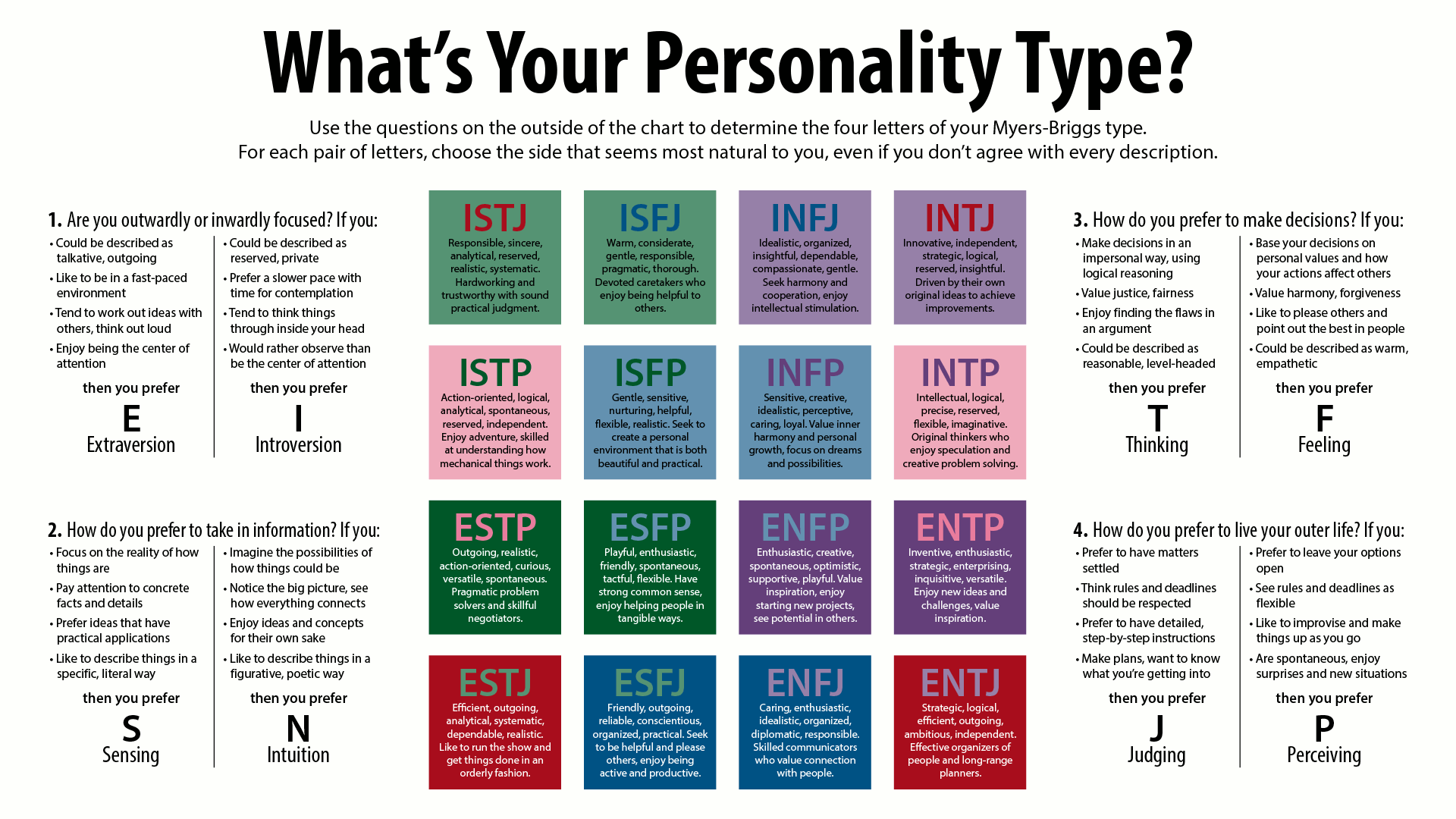
Myers-Briggs types. Adapted from http://commons.wikimedia.org/wiki/File:MyersBriggsTypes.png, released under CC BY-SA 4.0.

Click for larger version.

Some people put a lot of stock in the Myers-Briggs personality types. Other people compare it to a modern-day form of astrology, with all sixteen types being desirable in their own way and people choosing to self-identify with the commentary from their specific type through a process of self-directed cold reading. I tend to be somewhat more towards the latter end of the spectrum – but then, as an INTP, I would say that.

That said, I did enjoy the 16personalities.com summary of the INTP type. It’s quite possible that if you’re a MB person, you might have been able to see it coming through in this blog; “They love patterns ((…)) people with the INTP personality type tend to share thoughts that are not fully developed, using others as a sounding board for ideas and theories in a debate against themselves rather than as actual conversation partners“. Guilty as charged.

I also enjoyed the graphic at the top of the Prelude Character Analysis page for the personality type, being a certain sort of logic puzzle. It probably shouldn’t be a surprise that I thought “I recognise that puzzle – and I like it”! It might also explain why this blog keeps a diffuse focus in puzzle adventures and tries to interest people in logic puzzle competitions.

So this post is principally directed towards those who do tend to give credence to personality typing, specifically the MB types; if this isn’t for you, there’ll be another post along tomorrow.

Do exit games tend to attract certain sorts of personality types? Do certain sorts of puzzles in exit games tend to attract certain sorts of personality types? Is there any social science, pseudoscience or just plain tried-and-tested anecdotal received wisdom over why certain sorts of puzzles – irrespective of the quality and originality with which that puzzle is implemented – tend to play well with the sorts of people who would pay money to play an exit game? Could sites do more to help people find which of the several games they offer they would most enjoy based on players’ personality types? (Right, that’s almost enough underdeveloped theories for one post, you lovely sounding-board.)

I also enjoyed reading this recent Escape Games Review post, hinting at an exit game, themed around the Seven Deadly Sins, where every team member started off in a sin-themed mini-room of their own which they had to escape solo before they could work together towards a group victory. Could there some day be an exit game where players had individual puzzles to solve that were tailored towards their personality types – either to play to their strengths, or to force them to overcome their weaknesses?

A random thought about how friendly things are

animal-friendsGratuitous cute shot? There’s a little more to it than that, even if only a little.

Apropos of not much, one pleasing observation relating to the exit game hobby is how little disagreement and rivalry it has seen. It’s not as if – at least so far – there has been a tendency for people to swear allegiance to one brand of exit game and disdain the others, or those who are fans of others. When so many hobbies tend towards the tribal, it’s a pleasure that there has not been a sense of trying to establish commonality through a shared enemy. It’s fine to play some games from one company and have a great time, then play games from another company and enjoy them as well, and nobody makes accusations of a lack of loyalty.

Even the companies’ owners are on good terms with each other, as far as this site has been able to tell. (Some countries have seen occasional malign practices, but no authenticated evidence of them having spread to the UK yet.) This site tends to believe that competition isn’t a zero-sum game and a rising tide lifts all ships. It’s also true that different businesses’ games aim to do slightly different things; it’s cool that different sites emphasise subtly different emotional experiences.

At a guess, there are two reasons for the lack of development of brand… loyalty isn’t the right word, jingoism may come closer. The first is that, broadly, people will only play each game once and develop their skill at exit games in general rather than one exit game in particular, so people don’t need to feel the need to validate themselves by promoting the skill they have developed at their specific game through promoting that game at the expense of others. The second is that exit games tend to attract those with a taste for the thoughtful, possibly at the expense of the self-aggrandising.

The hobby is all the better as a result of it!

Mechanics Monday: Tutorial Mode

Video game "Tutorial Mode"The excellent Shut Up & Sit Down board games review site sporadically releases podcasts; one of them discussed, among many other things, the question “What can board games learn from video games?” Good question, and the obvious parallel question runs “What can exit games learn from video games?“. Especially because, arguably, the answer could be the same.

Many video games have tutorial modes which briefly introduce the mechanics of the game, often one at a time, often by making players learn through doing them. Not many board games have such a tutorial mode and there is an argument that that could be as good, or better, a way to learn a game’s rules than a rulebook. So the question is: could the same principle be used by exit games? Could an exit game start with a tutorial mode… or, perhaps, a tutorial room?

A tutorial room might have as few as three or four puzzles and be designed to be beaten within low single digits of minutes. It could be extremely small and would be designed to be extremely easy to reset, if work is needed to reset it at all. It would help the less confident teams out so that they might hit the ground running when they go into the “real” room. It could help people learn what they’re required not to do for safety reasons. It would offer a perception of extra value. Lastly, it could be used to… not mislead, but explore design choices that were deliberately not incorporated in the real room.

Yesterday, this site discussed Dr. Scott Nicholson’s white paper, which has been updated since the last post with even more content. One particularly interesting suggestion in it is that hiding information by writing it in ink that might only be seen using a supplied blacklight is something of an exit game cliché in this day and age. Perhaps it might be appropriate to use this mechanic in a tutorial room and not actually in a main room, in that case.

On the other hand, given that exit games have thrived already without needing tutorial rooms, perhaps this is a solution in need of a problem. It may well be that part of the thrill is exploring the possibilities for the first time in your first room, being dropped into it and discovering for yourself what you can do. Perhaps a tutorial room could be an optional extra for the most marginal and least confident participants.

Returning to the overarching question of what might be learnt from video games, Dr. Nicholson also writes: Since escape rooms are hoping to meet the needs of many different player types, they should allow the players the ability to set their game mode. This will provide a way for a group of players to communicate to game staff what kind of game experience they are seeking. ((…)) Facilities with a human gamemaster can easily adjust the difficulty of the game experience by giving more frequent or more cryptic clues. ((…)) Another tip to take from videogames to enable a better player experience is to allow teams to switch to an easier mode while playing the game, so that if they are frustrated, they have a way to resolve that frustration before the game is over. There is some established practice in this regard: De Code Adventures of Canada offers a choice of three levels of difficulty in this regard, though it’s not clear whether the extremely sensible “jump down a difficulty level while the game is in progress” option is possible.

One way for an exit game to conclude, which wouldn’t be appropriate for many themes but could be hard to beat thematically for others which nod more directly at video games, would be for the countdown clock to count down to zero and then display the familiar “GAME OVER” motif. People would expect that. However, if beneath “GAME OVER”, there were to be a secondary message of “CONTINUE?” and then an additional short countdown timer, that would surely play with a few sets of expectations, maybe in just the right way!

An academic approach to exit games

scholarshipOne of the most interesting developments in the world of exit games over the last few months has been the scholarly investigation undertaken, as discussed, by Dr. Scott Nicholson, a Professor at Syracuse University in New York state. Dr. Nicholson has a long history in research with a focus (among others!) into different forms of play in the context of informal learning spaces such as libraries.

Late last year he launched a survey of exit game facilities, discussing the thinking behind his survey at his site Escape Enthusiasts. This has developed into a Google Group for discussion of the genre, with a counterpart Facebook group as well. The highlight has been publication of (at least an early version of) the white paper arising from the survey, which gets this site’s highest recommendation as a must-read for business owners and players who want to see behind the scenes.

One particular highlight of the white paper is the very neat way that it handles the claim that exit games date back to Silicon Valley in 2006. Additionally, it presents remarkably comparable prior art dating back at least a decade further to (as discussed) a series of games run at the LARP-themed International Fantasy Gaming Society’s “Once Upon A Con” events, which created a series of temporary rooms through hanging up tarpaulins and challenged teams to make their way through within time limits. It’s always an exciting possibility that there are other, similar games from decades ago that time has forgotten and that might present themselves again some day.

The demographic information that the white paper presents is fascinating, with the most robust attempt yet to compare self-reported practices in exit games around the world, with the best corpus of data yet collected from English-speaking Asia, as well as Australia, Europe and the Americas. This will inspire and inform those looking to set up their own new business, as well as those looking to develop their existing one. There’s plenty of information collected, too, about what might be found inside these rooms as well as who might be playing them, and about what just might be possible and practicable inside a room.

This site has always deliberately erred on the side of being relatively liberal in its focus with discussion of near-topic games such as True Dungeon, but did so on a vague sense of it being hand-wavily interesting. The white paper takes the scholarly approach that these things are not just interesting, but they are relevant because they have identifiable influence, even if at a remove or two, on the way in which the world knows exit games today and how it might know exit games in the years to come. Six different influences are identified and it takes a real breadth of ludic knowledge to pull them all together.

Jumping from the start to the end, the notion in the white paper that most excited this site is the counterpart way that exit games are put in context as a subset of live-action adventures. Look at it another way: if you look up an exit game on TripAdvisor, it’ll be ranked in the context of “Fun Activities and Games”, and it’ll compete against – for instance – paintball, go-karting, casinos, laser tag and soft play. Is this a rag-bag assortment or are there lessons to be learned for exit games from some of them? Not so much from casinos and probably only tangentially (in the briefing-with-instructions, activity, debriefing schedule) from go-karting – but, as for the others, maybe there’s more in common than you think. If people like laser tag because they want to be inside a video game like Halo, perhaps they like exit games because they want to be inside a video game like Myst.

This site enjoys reading about live-action adventures, though sometimes hiding behind the sofa. This site isn’t going to become a live-action adventure blog, though. (Laser tag, although it will always be cool, is moving in a direction that this site does not appreciate so much; it’s becoming much less Half-Life and much more Call of Duty. No thanks.) Additionally, this site has always considered interactive theatre to be on the border of its remit, with playable theatre (if that’s a term anybody else uses, noting the many meanings of the word “play”…) definitely on-topic.

Putting it all together, this site loves puzzle adventures; they might involve being in a room, they might involve being in a puzzle hunt (whether online or in person), they might involve being part of a competition. However, it’s much easier for a puzzle competition to feel like an adventure in your head if there is some structure, context and persistence to them, rather than just being one-off tests – for instance, the adventure of being part of a team and helping your team advance through your progress. If this breadth of approach isn’t to your taste, other blogs are available. You should start your own; this site would link to it!

Looking forwards, Dr. Nicholson will be the keynote speaker at an upcoming “escape room Game Jam” held at MIT in greater Boston. Teams will have (nearly) 48 hours to “create puzzles and games to be played within a pop-up escape room (…) based around a moment in an upcoming film“. (It’s not clear which film; a film will be screened at the start of the event, so that would seem likely to be the inspiration.) Intriguingly, this is being held in association with Red Bull and winning participants get an expenses-paid trip to Comic-Con 2016. Not bad! The event has sold out, but will be filmed and the material generated will be made available under a Creative Commons licence.

Perhaps, in time, the world at large might get to play the winning, or a composite, pop-up exit game when the film gets a wider release; it wouldn’t be the first film to have a pop-up exit game associated with it – the one associated with The Purge: Breakout showed what might be possible. It’ll be extremely interesting to see if anything ever develops as a consequence of this Game Jam and to follow additional developments as they arise.

Exit games have taken off so rapidly that the world can hope to attract attention from all sorts of different sources and to be intepreted in all sorts of different ways. The exit game world should be very grateful to have someone who has professional academic expertise casting an eye over it, as well as us amateurs; that might sound dismissive, but it’s intended as a compliment – remember, an amateur is someone who does something for the love of it.

(Unrelatedly, if you haven’t done so already, please would you consider filling out this site’s survey? Thank you!)

Spring 2015: where are the gaps in the UK market?

Regions of the UKAward yourself some smugness if you can recognise the (admittedly out-of-date, so no need to be pedantic) approximate way in which the countries have been divided above.

Every six months or so, this site looks at a snapshot of the UK market for exit games and analyses where the gaps are at that time. (See the older versions from September 2014 and March 2014.) Six months is practically the duration of a geological era considering how quickly the exit game market moves.

It’s possible that some of the first exit game room proprietors might have started business in the closest big city to where they happened to already live. However, if you had a choice as to where to set up business, where are the most obvious gaps in the market? Alternatively, where might people expect to see exit rooms coming soon? In early 2015, now that some of the most successful operations have started second or even third locations in different towns, where remains up for grabs?

The Brookings Institution analysed 300 of the largest metropolitan economies in late 2012 and identified 15 of them as being in the UK. At time of writing, here are the 15 largest metropolitan economies in the UK, alongside the number of exit rooms featured in each one. If there’s a large metropolitan economy without an exit room, there’s arguably a gap in the market there.

1. London: nine sites operating (HintHunt, clueQuest, Escape Land, Escape Rooms, Agent November, Escape Hunt, Room Escape Adventures, Mystery Cube and Lock’d) and at least three sites under construction (Enigma Escape, Mystery Squad and Quest Room) with rumours of at least a couple more
2. Birmingham: two sites operating (Keyhunter and Escape Live) and at least one site under construction (Panic!) with rumour of at least one more
3. Manchester: four sites operating (Make A Break, Breakout Manchester, Lockin Escape and The Escape Room) and two sites operating nearby (Clue HQ in Warrington and Escape Quest in Macclesfield)
4. Leeds-Bradford: two sites operating (Tick Tock Unlock and Locked In Games) and two sites operating nearby (The Live Escape in Huddersfield and GR8escape York in York)
5. Liverpool: four sites operating (Clue Finders, Tick Tock Unlock, Breakout Liverpool and Exit Strategy) and one site operating nearby (Clue HQ in Warrington)
6. Glasgow: one site operating (Escape) and one site under construction (The Room)
7. Nottingham-Derby: one site operating (Logiclock)
8. Portsmouth-Southampton: no sites operating or under construction known but one site operating nearby (Cyantist in Bournemouth)
9. Bristol: one site operating (Puzzlair) and one site operating nearby (Bath Escape in Bath)
10. Newcastle: three sites operating (Escape, Lost and Escape and Exit Newcastle)
11. Sheffield: two sites operating (The Great Escape Game and Crack The Code Sheffield)
12. Cardiff-Newport: no sites operating or under construction known
13. Edinburgh: three sites operating (Escape, Escape Hour and Can You Escape?) and one site under construction (Dr. Knox’s Enigma)
14. Leicester: one site temporarily closed (Cipher)
15. Brighton: no sites operating and only unconfirmed rumours of sites under construction

For comparison, the Dublin metro area (where XIT and ESCAP3D are in operation and Escape Dublin is under construction) would come just below number three in the above list.

Six months ago, this pointed to Merseyside, the East Midlands, Tyneside and South Yorkshire as being big gaps that have been filled extremely successfully over time. (Arguably Liverpool going from zero sites to four in the space of about four weeks might be filling the city more quickly than some of the proprietors would like.)

The updated data now points to South Hampshire and Wales as being the biggest gaps in the market at the moment, and Wales is such a popular tourist destination that it’s the place that this site keeps checking and checking to see whether there’s been a launch – but there’s really no evidence in either North Wales or South Wales. This site is convinced that someone could really clean up in Cardiff at the very least, but probably wouldn’t want to run the fourth site to open there.

Other than that, Brighton surely has the feel of somewhere really promising because of the number of tourists it gets and the extent to which it is famous for its creativity (though at least one major global brand lists it as “coming soon”) and there are Home Counties towns that have serious money (Reading and maybe Watford) and/or serious numbers of tourists (Southend) which might well sustain good business from people who don’t want to spend the transport costs to go to central London to play. Further afield, Stoke, Derby, Leicester and even Hull are all surely big enough to support a site each, and there’s evidence to suggest that other relatively small locations can support a “boutique” site which has such an elaborate and enticing game as to draw enthusiasts from further away.

Exciting times, though not without a note of hesitation. With forty-some sites up and running and likely at least another ten or twelve to come, this site would be somewhat more cautious than it would have been even six months ago about new sites’ prospects. That said, there are still very many (probably millions, certainly many hundreds of thousands) people who might only ever play an exit game once who are yet to play their one game, as well as those who might enjoy their first game enough to come back to play more, and those – who this site salutes! – who know the genre’s capability to thrill and devote themselves to seeing all there is to see.

The League Table: end of February 2015

Stacks of coins, increasing in height

This is the eleventh instalment of an occasional feature to act as a status report on the exit games in the UK and Ireland. On its own it means little, but repeated sufficiently many times it could be the basis of a survey of growth over time.

The Census

Category Number in the UK Number in Ireland
Exit game sites known to have opened 42 2
Exit game sites known to be open 38 2
Exit game sites in various states of temporary closure 2 0
Exit game sites known to have closed permanently 2 0
Exit game sites showing convincing evidence of being under construction 8 1
Exit game sites showing unconvincing evidence of being under construction 4 0
Exit game projects abandoned before opening 2 0

The term opened should be understood to include “sold tickets”, even when it is unclear whether any of those tickets may have been redeemed for played games; the definition of site should be understood to include outdoor sites and component parts of larger attractions that are played in the same way as conventional exit games.

This month, four sites have opened and Jailbreak! has moved from “open” to “temporary closure”, on the strength of expectations of a second, bigger, better and possibly permanent opening. March 2015 looks set to be the biggest month for exit games in the UK and Ireland yet, with seven UK sites and one Irish site all selling tickets for various dates over the course of the month.

The Report Card

Site name Number of exit rooms Number of different games Number of TripAdvisor reviews Number of 5/5 TripAdvisor reviews TripAdvisor’s “thumbs up” percentage Local TripAdvisor ranking
Agent November 2 2 27 26 100% 97
Bath Escape 2 2 69 57 95% 12
Breakout Games Aberdeen 3 2 – – – –
Breakout Manchester 7 6 260 235 97% 3
Can You Escape 1 1 67 65 98% 9
Cipher 1 1 – – – –
Clue Finders 2 1 9 9 100% 46
Clue HQ 2 2 306 288 99% 1
clueQuest 5 2 968 904 99% 17
Crack The Code Sheffield 1 1 7 6 – 61
Cryptopia 1 1 26 23 100% 15
Cyantist 1 1 10 9 100% 11
Escape Edinburgh 3 3 327 296 99% 5
Escape Glasgow 3 2 102 98 100% 1
Escape Hour 2 1 60 58 100% 8
Escape Hunt 10 3 86 66 93% 145
Escape Land 1 1 99 86 100% 64
Escape Live 2 2 27 27 100% 2
Escape Newcastle 2 1 30 26 100% 3
Escape Quest 1 1 27 26 100% 1
Escape Rooms 2 2 117 86 94% 152
Escape Rooms Plymouth 1 1 30 27 96% 6
ESCAP3D Belfast 1 1 112 85 87% 32
ESCAP3D Dublin 2 1 14 6 71% 191
Ex(c)iting Game 2 2 60 42 95% 9(*)
GR8escape York 1 1 34 34 100% 2
HintHunt 5 2 1208 1119 98% 22
Jailbreak! 1 1 – – – –
Keyhunter 3 3 57 30 82% 33
Lock’d 1 1 – – – –
Locked In Games 2 2 144 138 99% 2
Logiclock 1 1 15 15 100% 4
Lost & Escape 1 1 – – – –
Make A Break 1 1 57 38 85% 24
Mystery Cube 1 1 8 7 – 297
Puzzlair 2 2 114 109 99% 3
Room Escape Adventures 1 1 1 1 – 680
The Escape Room Manchester 5 5 40 39 100% 2
The Great Escape Game 1 1 49 47 100% 1
The Gr8 Escape 2 2 35 30 97% 18
Tick Tock Unlock Leeds 1 1 342 328 99% 1
Tick Tock Unlock Liverpool 2 1 13 13 100% 23
XIT 4 4 14 10 100% 108

This needs to be taken with a heavy pinch of salt. This site supports all the exit games that exist and will not make claims that any particular one is superior to any other particular one. Please note that the TripAdvisor rankings represent a wide variety of locations and cannot be directly compared against each other. In fact, it’s definitely pushing it even to compare the TripAdvisor rankings of two exit game sites in the same city, and here’s why:

What a palaver; TripAdvisor have been playing around with their ranking system again. On balance, this site believes that the latest round of changes are a marginal net positive for exit games. It appears that sites will still be compared against other activities (or, in one asterisked case, attractions) in the same location, and this month, the rankings quoted above are the overall activities rankings. On the other hand, if you go and look at the TripAdvisor page for any particular site, you will see a ranking not relative to activities but to some smaller category. Normally this is Fun & Games, but sometimes it’s whatever else TripAdvisor feels like; at least one city has its indoor exit games ranked under Outdoor Activities. If you look at TripAdvisor on a mobile device, it’ll show you the activities rankings; on a desktop, the Fun & Games rankings.

One happy conclusion of this is that, for instance, six of the top ten listings in London for Fun & Games are all exit games. That can’t be bad at all. In general, the more sites that can be number one, the happier all round. One unhappy conclusion is that this will make the number one statuses slightly less meaningful and slightly less visible. One very confusing conclusion is that it’s evidently possible for one site to be ranked ahead of another in the activities chart but for the two sites to be ranked the other way around in the Fun & Games chart. (This happens in at least two cities.) There is no definite reason to prefer one ordering over the other.

In that case, why does this site quote the activities rankings? Two bad reasons: continuation of established practice, which is never a good justification on its own; even less justifiably, convenience – for these rankings are the ones quoted on this one single page. Thoughts on this are welcome (though responses from site operators of “do whatever makes my site looks best…” will be taken with a smile) but it may well be the case that next month the other set of rankings are quoted, or possibly even no rankings at all.

Nevertheless, congratulations to all those sites who are proud of the rankings they have worked so hard to achieve. It’s particularly delightful to see Sheffield’s The Great Escape Game reach number one, and also at least three sites making very rapid progress to reach number two in their city as well. There are many other new sites where highly elevated rankings are surely just a matter of time and continued excellent reviews, as well.

This site makes an estimate that the number of people who have played at least one exit game in the UK or Ireland, at any point in time up to the end of February 2015, is 155,000. (This estimate is quoted to the nearest 5,000, but the site would not like to claim more confidence than “…to within an order of three either way”.) As ever, if someone plays more than one game at the same site, this figure still only counts them once, and this number is only really meaningful in the context of this site’s previous estimates. The other usual caveat is that this figure may exclude data from locations about which this site is ignorant – and in researching this, this site has just found another site that opened in early January. More about that soon!